Les taux d’intérêt augmenteront probablement dans les mois à venir, selon l’économiste en chef de la Banque d’Angleterre
"Nous avons encore beaucoup à faire", déclare Huw Pill après une augmentation à 4% le mois dernier alors que la Banque cherche à lutter contre la hausse de l'inflation. La Banque d'Angleterre devra probablement relever…
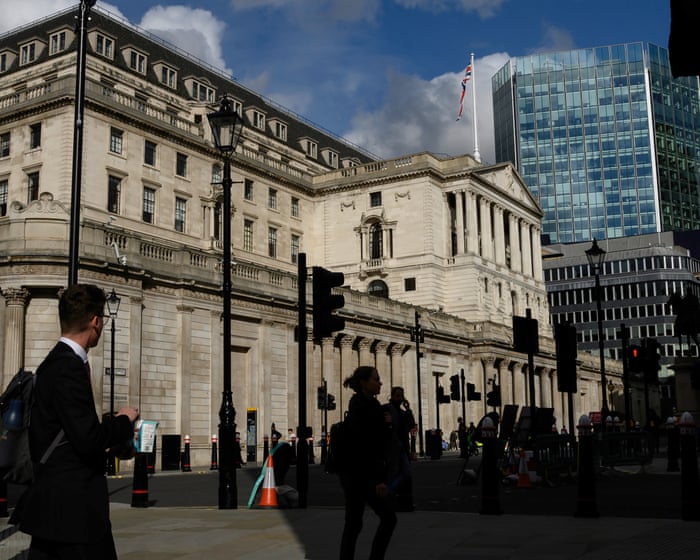
Interest rate rises likely in coming months, Bank of England economist says ‘We have further to go,’ says Huw Pill after increase to 4% last month as Bank seeks to tackle rising inflation
The Bank of England will probably need to raise interest rates next month and again in early 2027 to combat rising inflation, its chief economist has said.
Signalling a sharp rise in mortgage payments for an estimated 2.3 million homeowners who will have to refinance their loans next year, Huw Pill said that while the decision to nudge interest rates from 3.75% to 4% earlier this month was a “significant step” towards getting monetary policy into a better place, “we have further to go”.
Pill told the Financial Times : “My view would be, we will see evidence that motivates further rises,” adding that the central bank would “do what is necessary to get inflation back to 2% through time”.
The chief economist is one of a number of the Bank’s policymakers who believe the UK economy has gained in strength over the last year, handing workers the power to bid up wages.
Recent figures showed the economy grew by 0.7% in the third quarter, to give an annual rate of growth that was only surpassed by the US among the G7 group of wealthy countries.
With inflation expected to rise to 5% in spring next year, driven by high oil and gas prices as a result of the Iran war, Pill expects public and private sector workers to demand substantial pay rises, which would keep inflation high for a longer period.
Pill said he considered an end to the US-Israeli conflict with Iran and a fall in energy prices to be a “very low probability”, signalling to the newspaper that he was poised to vote for another quarter-point increase next month.
“My bias, for what it’s worth, is that I worry about the inflationary impact being magnified by second-round effects,” he said, adding that he believed the central bank should have acted sooner to combat inflation. “In my view, we waited too long.”
While the Bank has not seen evidence of wage increases or companies being able to pass on higher costs to consumers, Pill said the absence of evidence was not evidence of absence.
“As we go into next year, we will begin to see some evidence, and it could play out in one direction or another — we’ll see.”
Financial markets expect UK interest rates to rise to almost 5% in 2027. Pill said these expectations were “not outrageous”, hinting that he could vote for more substantial increases in the cost of borrowing at the next meetings of the Bank’s monetary policy committee (MPC) because the “ability to be modest [in the scale of rate rises] has diminished”.
City analysts have interpreted the increasingly hawkish comments of Pill and other MPC members as making an interest rate rise in December almost inevitable. But there is disagreement about the strength of the economy, with many concerned that further increases in the cost of borrowing will hit the manufacturing sector and the construction industry, which has contracted for much of the year.
Households are also likely to cut back on spending in the new year, when the energy price cap is expected to rise to almost £2,000 for a typical home and council tax bills increase by an average of almost 5%.
Traduit automatiquement de l'anglais
Pas encore recoupée
Seule la rédaction The Guardian rapporte cette information pour l’instant. Elle reste « source unique » tant qu’une autre rédaction ne l’a pas confirmée.
- The Guardian14 nov., 13:33
| Éditeur The Guardian (niveau référence) | +82 |
| Chiffres vérifiables cités | +3 |
| Résumé détaillé | +2 |
| Total | 87 |
Méthode : les dépêches sont regroupées d’après les mots de leur titre et de leur résumé ; chaque rédaction compte une fois ; les chiffres sont lus tels que publiés. Rien ici n’est rédigé par une IA.