The climate crisis will destroy our economies – we learned this 20 years ago. When will we act?
The radical Stern report showed that a low-carbon future is also good economics. But it seems that capitalism needs a reminder Saving the only planet we have makes good economic sense. There is, after all, no money to…
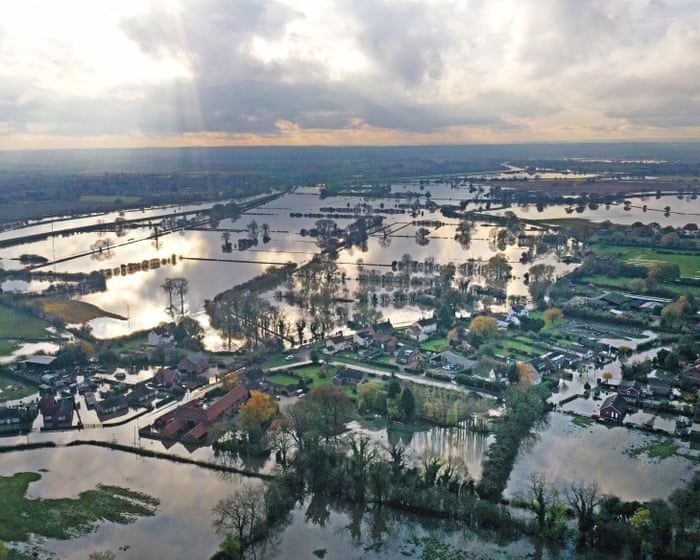
The climate crisis will destroy our economies – we learned this 20 years ago. When will we act? Fiona Harvey The radical Stern report showed that a low-carbon future is also good economics. But it seems that capitalism needs a reminder
S aving the only planet we have makes good economic sense. There is, after all, no money to be made on a dead Earth. There may be costs involved now, but they are worth paying to protect our children from certain destruction.
These propositions seem self-evident now. But two decades ago, mainstream economists had very different ideas. They had proved that the climate crisis would be a mere economic blip, easily absorbed by growing economies and therefore not worth spending money on. In their accounting, they considered ice caps and glaciers functionally worthless, that trees only add to GDP when they are cut down, and that a livable climate shouldn’t even merit a line on a spreadsheet.
What changed? Twenty years ago this week an earth-shaking report was published by Nicholas Stern, a former World Bank chief economist turned adviser to Gordon Brown. His review, The Economics of Climate Change, upended conventional wisdom among economists and dragged them into a new century. It set out, for the first time, in clear and bold terms, why investing in a low-carbon future makes economic sense .
The Stern review, in 700 dense pages full of graphs and data , is a model of transformative thinking. Using standard economic tools and methods, and in ways that other mainstream economists could understand, Stern made three key, and at the time radical, conclusions: that the costs of inaction on the climate were greater than the costs of action; that the climate crisis was a market failure; and that economic growth was compatible with cutting greenhouse gas emissions.
Stern’s crucial insight, the revolutionary idea on which his whole thesis turned, was that future generations have as much right to be born as we did. Traditional economics mistrusts anything that could happen in the future , applying a “discount rate” to it. Likely future profits are reckoned as lower in value than those of the present, as are likely future losses.
That might make sense when compiling companies’ accounts, as it prevents them over-selling themselves on optimistic assumptions. But applying a discount rate where the climate is concerned is a gross distortion – effectively, it means future lives are assigned less value, and so taking actions now that protect children when they grow up are made to appear uneconomic.
To gauge how startling this proposal was at the time, consider William Nordhaus, former professor of economics at Yale, whose work was the previous standard for climate economics. He confidently asserted in the early 1990s that countries should budget for “moderate” global heating , of about 3C to 4C above preindustrial levels, because below that the cost of cutting greenhouse gas emissions would outweigh the damage of climate change. In order to reach these conclusions, Nordhaus’s work relied on the same “discounting” assigned to future damage and future lives that Stern set out to challenge.
Not cross-checked yet
Only The Guardian reports this story so far. We show it as a single source until another newsroom confirms it.
- The Guardian28 Oct, 09:00
| Publisher The Guardian (reference tier) | +82 |
| Detailed summary | +2 |
| Total | 84 |
Method: reports are grouped by the words of their headline and summary; each newsroom counts once; figures are read from the reports as published. Nothing here is written by an AI.