The company even set up a commando to understand what is wrong: how German contracts poison Alstom, whose profitability is falling again
The industrial group again lowered its outlook for the 2026/27 financial year. Specifically, when the railway group receives many orders, it does not deliver fast enough and this is not new.
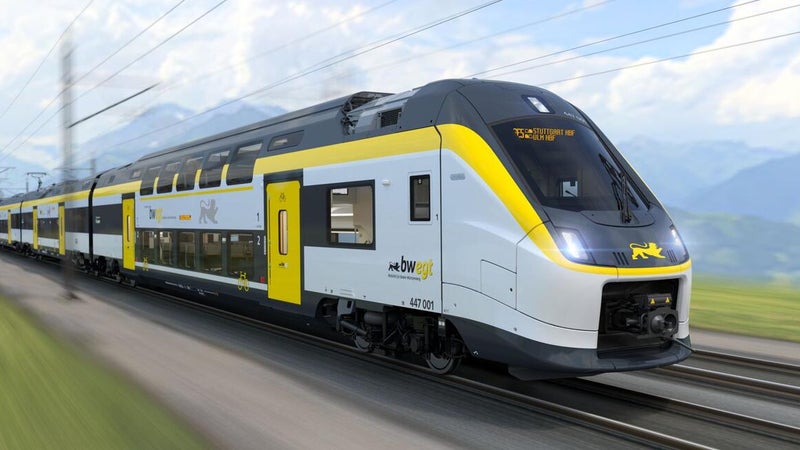
A fall of up to -30% on the Paris stock exchange this Monday morning, a price almost at its historic low, Alstom is experiencing a new bloodbath after a second warning on results this year, linked to the difficulties in producing its Coradia Max trains intended for Germany despite an order book full as an egg. While the group was generally counting on 4,500 cars delivered during the period, this objective was lowered to 4.
000, mainly because of German contracts. “We are addressing our execution difficulties with lucidity and vigor. We have the liquidity necessary to act.
We are strengthening structural measures with one priority: to better execute our contracts and ensure our debt reduction", comments Bernard Delpit, financial director of the group. "Today's announcement reflects the consequences of this exercise, carried out with the objective of normalizing the group's performance from the next fiscal year", assures Martin Sion, general manager of Alstom, quoted in a press release from the group. Concretely, if the railway group receives a lot of orders, it does not deliver quickly enough and this is not new.
The difference between money coming in and money going out is negative at 1.248 billion euros, compared to 740 million a year earlier. The six contracts signed in Germany for six landers (German regions) for Coradia Max regional trains are therefore weighing down the group's profitability. “Since my appointment as CEO in April 2026, I have called for rigorous identification and systematic escalation of risks and opportunities at project level, mobilizing dedicated teams of Alstom experts on the most critical projects, including Coradia Max,” said Martin Sion, Alstom’s new CEO.
Indeed, it was indeed a commando team that was sent to Germany to examine the problems linked to this project. And his conclusion was quite simple, a reevaluation is necessary. Faced with these difficulties, Alstom announced an “ongoing in-depth review of organizational and operational models, expected to result in decisions by early 2027”.
Commando team However, these difficulties are not new. These contracts signed by different German landers are massive and old. We are talking about almost 200 trainsets and first orders signed in 2021, notably by Baden-Württemberg for 2.5 billion euros, trains entirely assembled in Germany.
In total, orders amount to 5 billion. What happened? Delays multiplied from the development sequence of the Coradia platform (the base corresponding to two-level trains capable of traveling at 200 km/h), well before the production of the first train.
This engineering period took much longer than expected causing cascading delays and additional costs. To summarize, Alstom burned much more cash than expected even before the first turns of the screw. Then, while Alstom's German factories began to release the first trainsets, the tests carried out on the new equipment were not satisfactory, even causing production stoppages and therefore further delays.
Machine-translated from French
Not cross-checked yet
Only BFM Business reports this story so far. We show it as a single source until another newsroom confirms it.
- BFM Business2 Nov, 12:51
| Publisher BFM Business (established tier) | +76 |
| Detailed summary | +2 |
| Total | 78 |
Method: reports are grouped by the words of their headline and summary; each newsroom counts once; figures are read from the reports as published. Nothing here is written by an AI.