The ECB opts for the status quo despite inflation close to 4%: Frankfurt leaves its rates unchanged but the markets are already anticipating a further increase in December
The ECB is keeping its rates unchanged despite inflation significantly above its target. Observers, however, foresee a further increase in December.
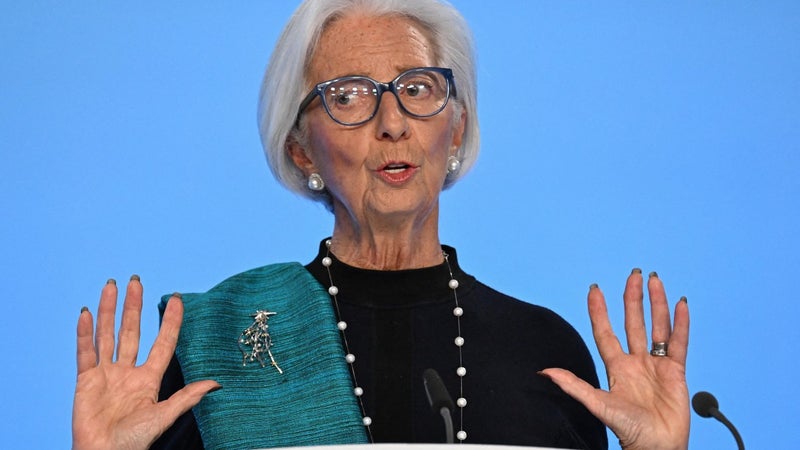
The European Central Bank opts for the status quo. The Frankfurt institution left its interest rates unchanged on Thursday, despite persistent inflation which is now approaching 4%, almost twice as high as its target set at 2%. The ECB's main rate therefore remains at 2.5%, a decision widely expected and partly overshadowed by the announcement of the resignation of its president Christine Lagarde, who will leave her post on February 7.
The ECB, whose mission is to ensure price stability in the euro zone, has already raised its key rates twice this year, in June and September, and should resume its cycle of monetary tightening in the months to come to try to stem the resurgence of inflation caused by the war in the Middle East (+3.8% in September). A first increase is expected by the financial markets from December. By raising its rates, which guide those of commercial banks, the European Central Bank increases the cost of credit and slows down the economy, which is supposed to limit the contagion of the surge in energy to other prices.
At this stage, the spread remains limited and the ECB still considers itself "well placed to deal with the current uncertainty", even if "the continued rise in energy prices poses upside risks to the inflation outlook and downside risks to the growth outlook". “While the full effects of the energy shock are not yet being fully felt, core inflation has remained broadly stable so far and wages are not showing a significant reaction at this stage,” writes the European Central Bank in its press release announcing the status quo. To make its decisions, the ECB must also take into account the economic situation.
However, growth is showing signs of weakness in the euro zone. One of the indices measuring private sector activity thus slowed more than expected in October, partly because of the difficulties in France, where activity in services was particularly slowed down. This "suggests that the bloc's economy is starting to weaken under the weight of rising commodity prices and tightening financial conditions," said David Powell, Bloomberg's senior economist for the euro zone, in a note published before the ECB's announcement.
Machine-translated from French
Not cross-checked yet
Only BFM Business reports this story so far. We show it as a single source until another newsroom confirms it.
- BFM Business29 Oct, 14:17
| Publisher BFM Business (established tier) | +76 |
| Detailed summary | +2 |
| Total | 78 |
Method: reports are grouped by the words of their headline and summary; each newsroom counts once; figures are read from the reports as published. Nothing here is written by an AI.