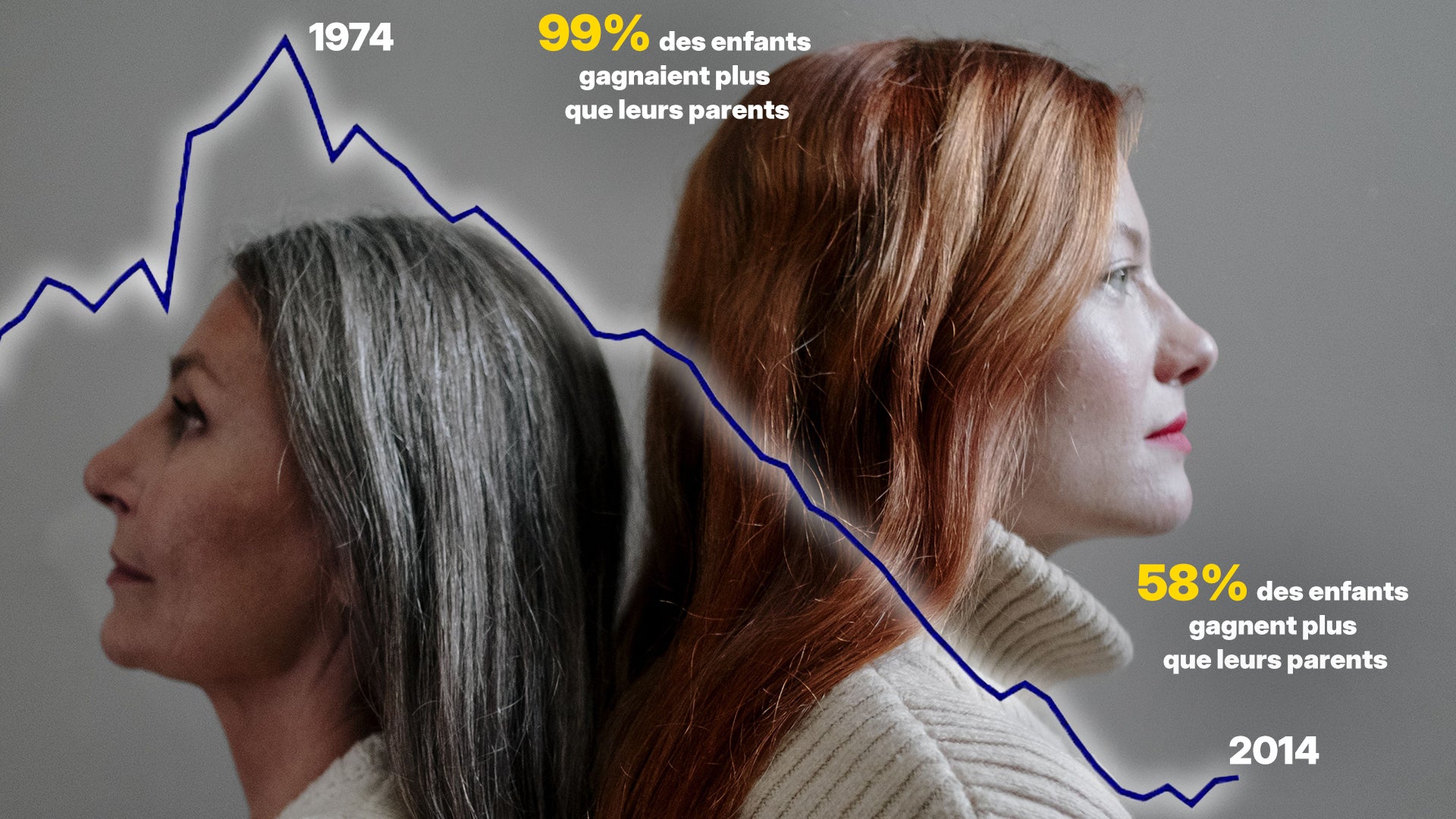
Do you earn more than your parents at 30? Before this was the case for 95% of French people, now it is more than 58%, but is this really proof that we lived better before?
In all developed countries, the proportion of individuals receiving higher incomes at age 30 than their parents at the same age continues to decline. The slowdown in economic growth since the prosperous period of the…
In France, Italy, Germany... At home and among our neighbors, the demonstrations of recent weeks have mainly been motivated by the deep concerns of Europeans about the cost of living and its consequences for their purchasing power. “We have a problem being able to live with dignity from our work,” summarized Marylise Léon, general secretary of the CFDT, on BFMTV. With the consequence of an increasingly shared feeling within the Old Continent: that of downgrading.
In France, this fear of no longer being able to live better than previous generations is already clearly in the majority. According to a study by the High Commission for Planning published at the end of 2025, three out of four French people judged that “it was better before”. And two thirds of young people under 35 also subscribed to this declinist vision, fueled by the sad observation that “work no longer pays”, or at least no longer enough to significantly increase their standard of living.
A reality which is partly reflected in the figures. According to a study carried out in 2022 by Yonatan Berman, lecturer in economics at King's College London, 58.5% of French people born in 1984 received real incomes at age 30 (after taking into account inflation) higher than those of their parents at the same age. This is certainly more than half but significantly less than the more than 95% of the generation born in 1944, or the 74% of the 1965 generation.
The slowdown in growth has weighed on wage increases. Due to a lack of available data, this measure of "absolute mobility" - which here assesses the extent to which individuals live better or worse than their parents in terms of income - says "nothing about people who are between 20 and 35 years old today", explains Yonatan Berman to BFM Business. It is therefore "difficult to be categorical but the rate probably remained at a low level, between 55 and 60%" given the downward trend observed over the long term. In other words, the social elevator still works but less and less quickly.
Because “absolute mobility depends on economic growth and the distribution” of the fruits of this growth, explains Gustave Kenedi, senior economist at the Institute of Public Policies (IPP). However, in the case of France, the decline "is explained mainly - although not exclusively - by the slowdown in growth, rather than by the increase in income inequalities which played a lesser role", observes Yonatan Berman. The generations that entered the labor market in the second half of the 20th century took full advantage of the dynamic growth of the Thirty Glorious Years (more than 5% per year between 1949 and 1974).
Machine-translated from French
Not cross-checked yet
Only BFM Business reports this story so far. We show it as a single source until another newsroom confirms it.
- BFM Business8 Nov, 06:59
| Publisher BFM Business (established tier) | +76 |
| Detailed summary | +2 |
| Total | 78 |
Method: reports are grouped by the words of their headline and summary; each newsroom counts once; figures are read from the reports as published. Nothing here is written by an AI.