“The enemy has targeted our passenger services”: under the threat of Russian drones, trains continue to run in Ukraine despite the attacks, at the cost of 100 to 200 evacuations every day and long hours of delays
Faced with incessant attacks by Russian drones, train journeys on the Ukrainian railway network have become grueling expeditions for passengers.
On board the fast train linking kyiv to Poltava, located 300 kilometers east of the Ukrainian capital, Daryna Styrchuk, 24, is worried because the war is making this trivial journey a dangerous expedition. “I didn't sleep well, I was worried because of the air alerts, the delays and the evacuations,” the young woman confided to AFP during the trip. The train is the only way for her to reach her family.
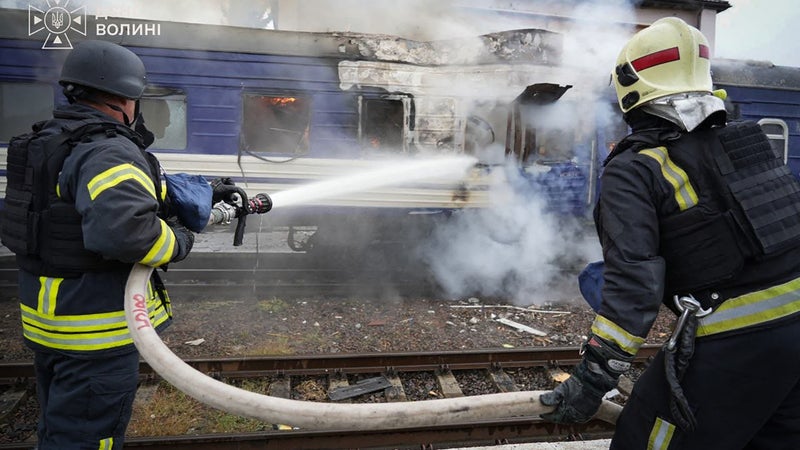
But ferocious Russian attacks on trains, stations and railway infrastructure have transformed simple journeys into grueling, potentially fatal expeditions. Thursday, a week after AFP's trip alongside the young Ukrainian, a Russian drone crashed in Dnipro, on a platform near two stopped trains. At least 14 people died.
Nearly five years after the start of Russia's invasion of Ukraine, the train has taken on crucial importance for domestic travel, as well as to and from abroad, as Ukrainian airspace has been closed to civilian aircraft. Since the beginning of 2026, Russian attacks have damaged 4,856 railway facilities, including 380 locomotives and 146 wagons, according to Ukrainian Railways.
"The enemy has targeted our passenger services," Oleg Golovashchenko, director of the public operator's passenger transport company, told AFP. “Evacuation, evacuation!” Also, faced with the increase in Russian strikes, Ukraine interrupts and evacuates the trains at the slightest risk of attack.
From now on, there are 100 to 200 train evacuations per day, which cause delays of several hours in the country's stations. The Kharkiv-kyiv line, used by AFP journalists, connects the two largest cities in Ukraine. Trains coming and going from the northeastern terminus, about 30 km from the Russian border, frequently stop along the way, under threat of attack.
As the night train departed from Kharkiv, passengers were preparing to sleep when they were informed that they had to be ready to evacuate urgently. “We put them on the train, we have to take them to their destination alive,” Mykola Kryvenko, a 50-year-old controller, told AFP. Several hours after departure, the peace is suddenly shattered by the sounds of hurried footsteps and knocking on the compartment doors.
“Evacuation, evacuation!” the flight attendant shouts. Russian drones are nearby.
In a few minutes, the passengers drag their anguish onto the platform, on the lookout for the slightest noise coming from the sky. And calls to move away from the train are soon drowned out by the din of the approaching drone. People start running in search of shelter.
Shortly after, an explosion in the distance irradiates the sky. The passengers were unhurt. Among them, Kateryna Kumratova, a 35-year-old marketing specialist, is traveling with her four-year-old daughter, Nina, whom she is taking to a shelter.
Machine-translated from French
Not cross-checked yet
Only BFM Business reports this story so far. We show it as a single source until another newsroom confirms it.
- BFM Business31 Oct, 14:43
| Publisher BFM Business (established tier) | +76 |
| Detailed summary | +2 |
| Total | 78 |
Method: reports are grouped by the words of their headline and summary; each newsroom counts once; figures are read from the reports as published. Nothing here is written by an AI.