Draisy: lighter and half‑priced compared to a TER – the SNCF and Lohr “feather‑weight” battery train could run on small routes in Grand Est and Occitanie as early as 2029
Part of the France 2030 programme and backed by the State through Ademe with a budget of €12.8 million, this lightweight battery train is intended to replace diesel units that are slated for withdrawal from small lines…
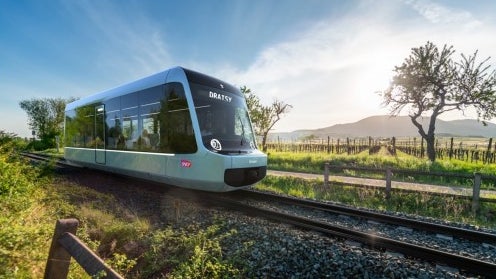
This is a land use planning issue. How can we keep alive the small or very small local and rural railway lines, little used but often essential to open up territories? How can we prevent many of them, due to attendance or obsolescence, from closing one after the other?
How can we ensure that these lines are levers for modal shift by choosing the train, rather than the car? These small lines represent a third of the French rail network, or 9,137 kilometers of tracks with little or no electrification.
Between those which are no longer operated, those which threaten to close and those which see diesel trains running which will soon be scrapped, the SNCF has been looking for concrete replacement solutions for several years. One of them is slowly but surely coming to fruition: the Draisy light train. It is impossible to (re)run conventional trains on these lines; this would have a cost that would be far too high for the regions (trains and modernization of the infrastructure) given their low attendance.
Twice as light and less expensive than a TER Carried by the SNCF group, manufactured by Lohr Industrie with the SMEs GCK Battery and Stations-e, as well as the Railenium Technological Research Institute, included in the France 2030 program launched at the end of 2021, supported by the State through Ademe and benefiting from a budget of 12.8 million euros, this light and battery-powered train is intended to replace trains to diesel which will be removed from small lines by 2030/2035 and/or to circulate on tracks not currently used. 100% electric, weighing only 22 tonnes, less than half of a TER for 14 meters long and capable of carrying 80 passengers (30 seated) at 100 km/h maximum, this train "is suitable for a small volume of traffic and allows a 50% reduction in operating costs. Its acquisition cost is also half as high as a classic TER: 2.5 million euros compared to 5.6 million euros", we explained David Borot, director of New Mobility Innovation at SNCF and director of Tech4Mobility, last year.
Assets that are anything but slight. This equipment is particularly suitable for journeys of between 20 and 100 kilometers, with an attendance of 1,500 passengers/day.
In the end, Draisy is not just a train smaller than a TER, it is above all a lighter and less expensive rail system, encompassing rolling stock, stations, battery recharging, "frugal" signaling, maintenance which fits into a very specific need: small lines, small ridership. During the InnoTrans 2026 exhibition in Berlin last September, its manufacturer Lohr, a French multinational specializing in the transport sector, based in Alsace, gave some news on the progress of the project. A prototype "mule" (the rolling platform without the body) is currently conducting tests on the Velim railway ring in the Czech Republic to evaluate its dynamic behavior and braking systems.
Machine-translated from French
Not cross-checked yet
Only BFM Business reports this story so far. We show it as a single source until another newsroom confirms it.
- BFM Business31 Oct, 15:13
| Publisher BFM Business (established tier) | +76 |
| Checkable figures cited | +3 |
| Detailed summary | +2 |
| Total | 81 |
Method: reports are grouped by the words of their headline and summary; each newsroom counts once; figures are read from the reports as published. Nothing here is written by an AI.