The whole world is snapping up their burrata and prosecco: but how does the Italian food industry grow faster than French gastronomy?
The international success of the Italian food industry cannot be explained only by the gastronomy of the Peninsula. It is also the result of redoubled efforts by the government and mobilization of businesses.
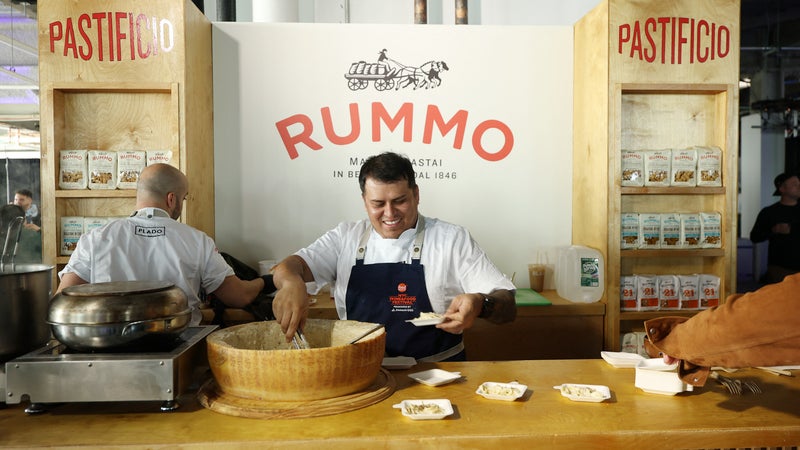
Once again, they triumph at the International Food Fair. As in the previous edition, in 2024, Italians are once again the largest number of exhibitors at this event which is being held this week near Paris. To the great despair of the National Association of Food Industries (Ania), they are ahead of the French at the most important global trade fair in the sector, although hosted by their country.
And this massive presence is neither accidental nor cosmetic. It reflects a real underlying trend: the Italian agri-food industry is increasingly exporting, and directly competing with its neighbor. In 2025, Italian exports of agri-food products and wine will exceed the record value of 70.9 billion euros, notes the transalpine equivalent of Business France (the Italian Trade Agency, Ita), based on figures from Istat (the equivalent of INSEE).
Compared to the previous year, these exports grew by 5%, despite geopolitical upheavals and in particular Donald Trump's customs duties. For its part, France exported 84 billion euros of agri-food products in 2025, a figure up 2% compared to the previous year. With a market share of 3.54%, Italy has become the eighth largest exporter in the world in the sector.
Its gap is narrowing with France, which however remains in fifth place, regretted last week the French National Center for the Promotion of Agricultural and Food Products (CNPA). Tourism based on gastronomy Several reasons explain this boom, analyzes Luigi Ferrelli, director of the Paris office of Ita. First of all, the growth of Italian agri-food exports goes hand in hand not only with that of the entire manufacturing export of the peninsula, but also with that of other interdependent sectors, notably tourism and catering.
“Italy is one of the first countries to have created eno-gastronomic tours to discover its different regions, and the French, Germans, Americans or Chinese who travel to Italy then want to relish our dishes at home,” notes Luigi Ferrelli. France, where Italian agri-food exports grew by another 6% in 2025, "is an exemplary case: more and more quality Italian restaurants are opening there", and paving the way even for products that are difficult to sell in France such as wine, he notes. The other reason for this success, according to him, lies on the supply side.
“Unlike French gastronomy, Italian gastronomy is not based so much on preparation techniques, but rather on the quality of a wide variety of products,” he observes. It thus responds to the growing demand for simple and healthy foods, which earned it UNESCO world heritage status in 2025, estimates Luigi Ferrelli. Public support and private initiative Public authorities also play an important role in this expansion.
“In recent years, the government has redoubled its efforts to support Italian companies internationally, including financially,” rejoices Luigi Ferrelli. “In 2026, our agency, which depends on the Ministry of Foreign Affairs, can count on an envelope one third higher than that of 2025. We have around 300 million euros for our promotional activities, including the organization of Italian pavilions at major international trade fairs,” explains the general director.
Machine-translated from French
Not cross-checked yet
Only BFM Business reports this story so far. We show it as a single source until another newsroom confirms it.
- BFM Business25 Oct, 07:59
| Publisher BFM Business (established tier) | +76 |
| Detailed summary | +2 |
| Total | 78 |
Method: reports are grouped by the words of their headline and summary; each newsroom counts once; figures are read from the reports as published. Nothing here is written by an AI.