Bidirectional Charging: Ford's Snub at Tesla's Pricey Ecosystem
By announcing a $30,000 electric pickup (approximately 27,000 euros) capable of powering a home without an expensive wall‑mounted inverter, Ford delivers a sharp rebuff to Tesla’s locked‑in ecosystem.
Receive a summary of important news every evening with Le Récap’
Is bidirectional charging poised to become the new electric car battlefield in the United States? “Make the best technology accessible to the majority, not just to the few,” published Jim Farley, the big boss of Ford, on LinkedIn this Tuesday, October 27, 2026. The message sounds like a direct attack against Tesla.
This technology (V2H, for Vehicle-to-Home) allows an electric car to transform into a giant generator to power a house during a power outage. With the increase in climatic disasters, the function is of increasing interest, especially since it can also reduce the electricity bill. However, the solution proposed by Tesla is accompanied by a particularly expensive installation. Ford, for its part, wants to make this function more affordable with its future pick-up sold for less than $30,000 (around 27,000 euros).
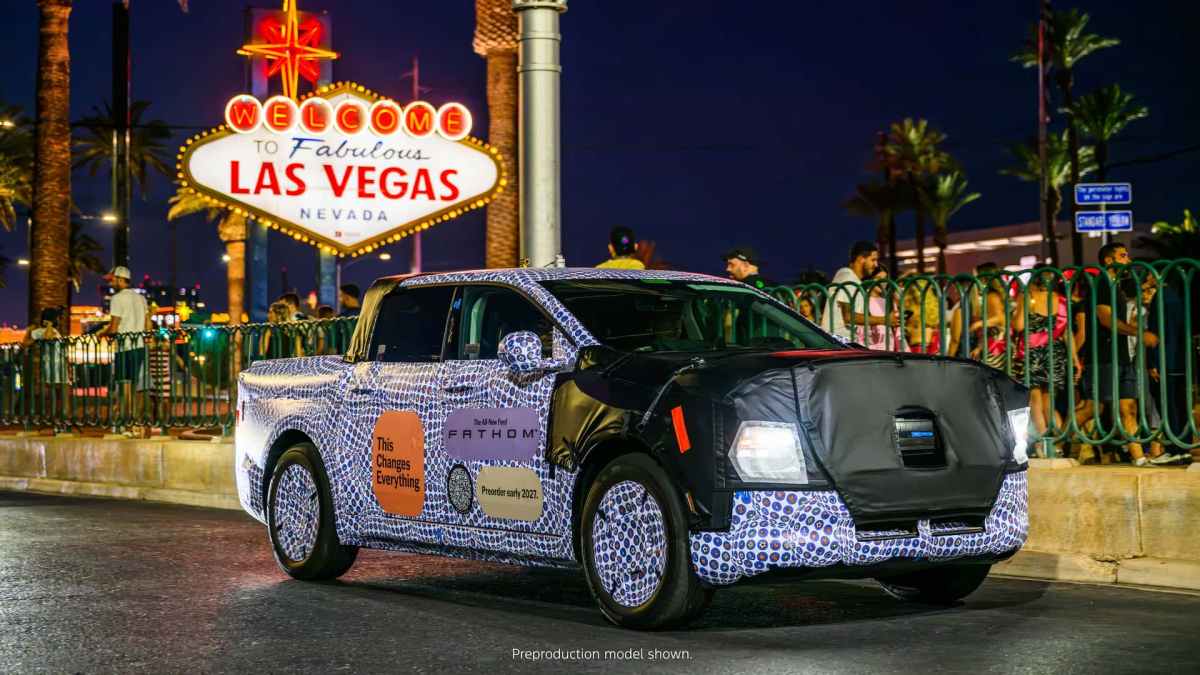
Ford's weapon for this new war against Tesla is called the Fathom. Ford even set its starting price this Tuesday, October 27 at $28,350. Pre-orders will open in early 2027, for deliveries later in the year. Tesla has been promising an electric car below this threshold for years, without ever having offered it to American buyers.
In its press release, Ford promises that the Fathom will be capable of delivering more than 10 kW of power directly to the home network. The technical originality does not lie in the power itself, but in the method: the engineering team succeeded in integrating the inverter directly into the vehicle.
Concretely, this means that the direct current (DC) from the battery is transformed into alternating current (AC) by the pick-up itself before being reinjected into the domestic network. It thus removes the obligation for the customer to purchase and install a separate wall inverter billed several thousand dollars. A simple compatible domestic charging station will be necessary, at a price that the Ford boss promises particularly low.
The idea is that the vehicle can serve as a backup generator in the event of a complete grid failure, but it can also help avoid the most expensive electricity hours to reduce energy bills. The principle will speak to French subscribers about EDF's Tempo offer, even if the Fathom is only announced for the North American market.
To prevent bidirectional charging from becoming an administrative headache, Ford has also set up, from July 2026, a working group with five North American electricity suppliers (PG&E, American Electric Power, BC Hydro, Consumers Energy and Exelon). Objective: define common rules for connection to the network before the arrival of Fathom.
At Tesla, the vision of domestic energy involves a proprietary ecosystem. If you want to rescue your home with your Model Y or Model 3, Tesla logically pushes you towards its own conversion and stationary storage solutions. The installation bill can then quickly double the price of entry into the world of V2H. It's a little different with the Cybertruck, whose minimum installation is lighter (but not the price of the vehicle). Tesla only guarantees the function on Model 3 and Model Y ordered since October 1, 2026, although the brand had announced it in March 2023.
Machine-translated from French
Not cross-checked yet
Only Numerama reports this story so far. We show it as a single source until another newsroom confirms it.
- Numerama28 Oct, 10:40Bidirectional Charging: Ford's Snub at Tesla's Pricey Ecosystem ↗Figures: 27 euros
| Publisher Numerama (general tier) | +72 |
| Detailed summary | +2 |
| Total | 74 |
Method: reports are grouped by the words of their headline and summary; each newsroom counts once; figures are read from the reports as published. Nothing here is written by an AI.