Stryker CEO Kevin Lobo says robots now do 2 of every 3 knee replacements - and he won’t build them in China because ‘the IP is a massive worry’
Kevin Lobo told Fortune that Chinese companies are “knocking off a lot of the other robots” as Stryker bets $400 million on a soft-tissue surgical robot.
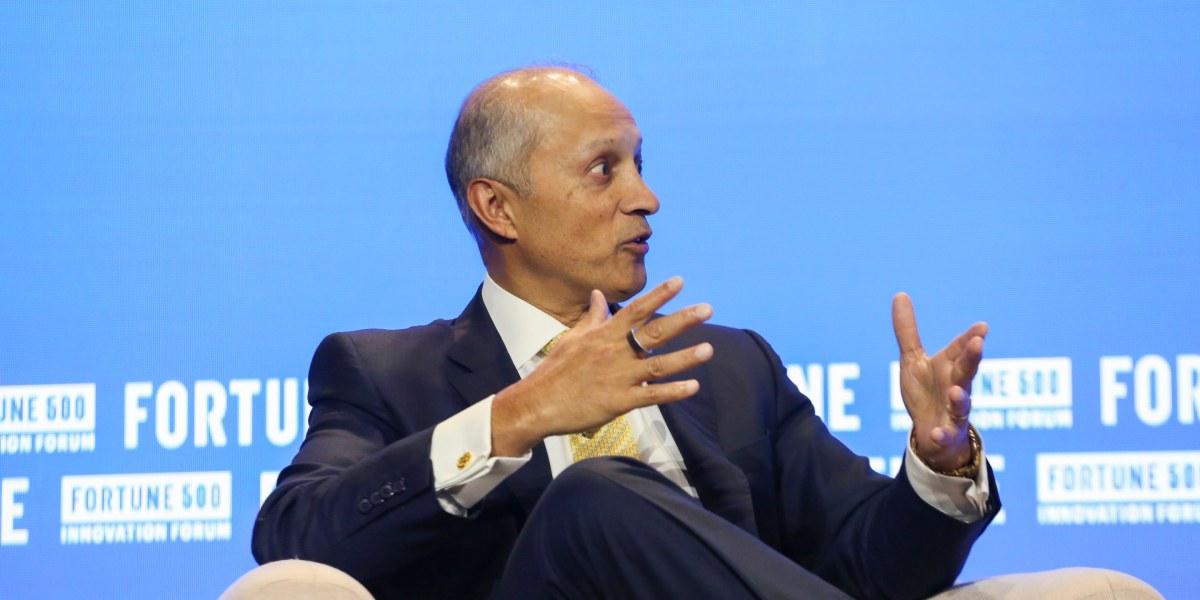
Stryker builds every one of its orthopedic surgery robots in the U.S. CEO Kevin Lobo says it will stay that way, because of what’s happening in China.
“We have no plans to make any robots in China. The IP is a massive worry,” Lobo said Monday at the Fortune 500 Innovation Forum in Detroit. “They are knocking off a lot of the other robots.”
Robots are now central to how Stryker sells joint replacements. Lobo said two of every three Stryker knee replacements are now done robotically, using its Mako system, which has been used in 2.5 million procedures in 47 countries. That makes the robot’s intellectual property a big part of what Stryker is selling. Meanwhile, Chinese makers are scaling quickly. MicroPort MedBot, a Shanghai company that makes a soft-tissue surgical robot called Toumai, said in June that it had passed 300 global orders, was installed in more than 60 countries, and could build up to 500 robots a year.
Lobo, who is Stryker’s chair and CEO, said one of Stryker’s “major competitors” had bought into a Chinese robotics company. He didn’t say which one.
Fortune ’s Andrew Nusca asked the panel what role the U.S. race with China plays in robotics: talent, intellectual property or supply chains. Lobo said Stryker makes its robots at home and ships them around the world.
Stryker is “scouring the market” to see whether Chinese companies can develop new kinds of robots for other parts of the anatomy, he said. He argued that engineering talent isn’t enough in his field without clinical experience. “They can have the best engineers. If they don’t have the domain experience clinically, it’s not going to be so easy,” he said. “So we don’t see them as kind of an imminent threat to our businesses.” Stryker thinks about Chinese companies “more opportunistically,” he said, “and we’re being very thoughtful about not making anything there that can be taken from.”
Lobo said the robot’s value is precision. The surgeon is still in the room, but the Mako arm makes the cuts, following a surgical plan built from a CT scan, with haptic boundary controls that he said provide one-millimeter precision. If a surgeon tries to cut outside those boundaries, “the robot won’t let them.” One surgeon told him recently that he feels like he’s almost cheating, Lobo said.
Robotic assistance is becoming the standard of care, he said. Orthopedic residents choosing where to train now ask one question first: “What robots do you have?”
Stryker also keeps the data. All the data the robot captures belongs to Stryker, subject to HIPAA and other rules, Lobo said. Its customer contracts let Stryker use it to tell hospitals, for example, why one surgeon takes longer than another.
Stryker’s next move is outside orthopedics. In October, it agreed to make a roughly $400 million preferred-equity investment in CMR Surgical, a London company that makes the Versius soft-tissue robot. Under the deal, Stryker becomes the exclusive U.S. sales agent for Versius and gets an exclusive option to buy all of CMR later, according to Stryker .
Lobo pitched it as a smaller, cheaper alternative in a market he said has “only one big company,” Intuitive Surgical, whose robot is “extremely expensive and it’s a giant robot.” He said CMR’s is about half the footprint and better suited to surgery centers doing gallbladder removals and hernia repairs. CMR spent 10 years getting to where it is, he said, but needs a company with Stryker’s resources, “because small companies, it just takes too long.”
Lobo described the U.S. FDA as “very friendly for innovation, much more friendly in the United States than we’re seeing in other countries around the world.”
The bet comes as Stryker’s hip and knee business has slowed. Last month the company cut its 2026 organic sales growth forecast to 6.5% to 7%, from 8.3% to 9.3% in July. “In addition to the softer market, we have not been winning at our historical rate,” Lobo told analysts on the earnings call , though he said Mako sales “have been strong again this year.”
Wendy Tan White, CEO of Intrinsic, a robotics-software company that Alphabet moved into Google in February, shared the stage with Lobo and made the case that the China race isn’t only about surgery. Cheaper hardware, plus AI that lets robots see and adapt in real time, means small U.S. manufacturers can now afford robots, she said. One customer is a small machine shop that uses a robot to tend a CNC milling machine and “can run an extra run overnight that they couldn’t before,” which lets it compete on cost “rather than in Vietnam or somewhere else in the world.”
“If you’re going to bring reshore manufacturing back to somewhere like the U.S., you actually need to bring that cost down and that skill base back,” she said. She called robotics “an enhancement to skilled working,” not a replacement for it, because hardware is limited by the physics of the world.
Lobo said the soft-tissue robots surgeons have been waiting for are close. “Trust me, it’s coming, and it’s going to come pretty fast,” he said. Stryker’s CMR deal is still subject to regulatory approvals.
Not cross-checked yet
Only Fortune reports this story so far. We show it as a single source until another newsroom confirms it.
- Fortune17 Nov, 17:48
| Publisher Fortune (established tier) | +76 |
| Checkable figures cited | +3 |
| Detailed summary | +2 |
| Total | 81 |
Method: reports are grouped by the words of their headline and summary; each newsroom counts once; figures are read from the reports as published. Nothing here is written by an AI.