In Bangladesh, workers from nearly 700 textile factories are on the streets: the government promises them an increase in the minimum wage in January (it is only 90 euros)
While workers at around 670 textile factories in Bangladesh have blocked their sites and demonstrated in recent days for better pay, the government assures that it will increase their minimum wages from January,…
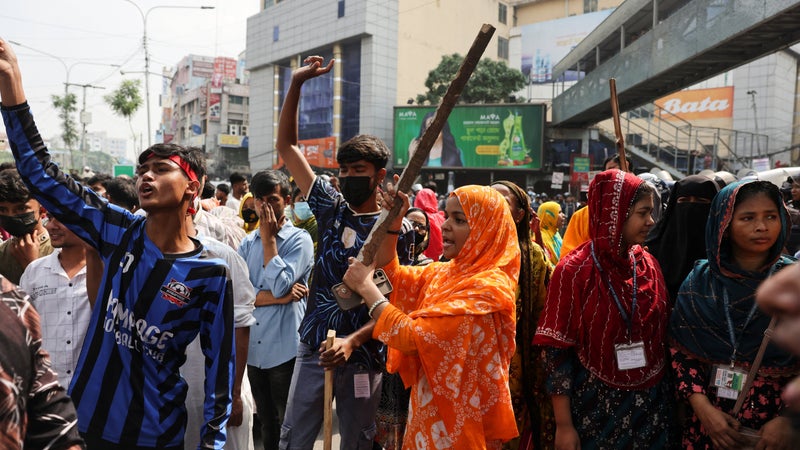
The minimum wage for workers in Bangladesh's textile industry will be increased from January, the ad hoc committee set up by the government announced on Wednesday, on the fifth day of the protest movement which is shaking the sector. Since Saturday, thousands of employees in this industry, vital to the country's economy, have been demonstrating every day in the capital Dhaka to demand an increase in their salaries, against a backdrop of high inflation and a global rise in energy prices. At the end of a meeting on Wednesday, the committee made up of representatives of employees and industry announced that it had agreed on the principle of an increase in the minimum wage, the amount of which will be fixed in December and which will come into force the following month.
"We will complete our work in December so that the workers can receive their revised salaries in January," ABM Shamsuddin of the Bangladesh Textile Producers and Exporters Association (BGMEA) told reporters. “We agree on this point,” confirmed an employee representative, Babul Akter. Remains to live on 21 euros per month For the fifth consecutive day, incidents again pitted strikers and the police on Wednesday in the streets of several districts of the capital Dacca, headquarters of the largest factories in the sector.
According to industry representatives, workers from at least 670 companies - the sector has around 4,000 - walked out on Monday. The employees are demanding a 140% increase in their monthly minimum wage, from 12.
500 takas on average today (90 euros) to 33,000 takas (220 euros) to compensate for the increase in the cost of living. "I don't have any money saved...
) so I don't have the means to pay for fish or meat regularly", lamented a worker from the district of Gazipur, Amena, on Tuesday. Once her rent has been paid and help is provided to meet her parents' needs, she has only 3,000 takas (21 euros) per month left to live on.
“It is no longer possible to live like this, but I have no choice,” she added, “the textile factories are our only available solution.” For Babul Akhter, general secretary of the Garment and Industrial Workers' Federation, "Bangladesh is among the countries in the world where wages in the clothing sector are the lowest", reports the Reuters news agency. “If factory owners cannot pay their workers properly, they should negotiate better prices with international buyers.
They cannot build a business on the backs of underpaid workers,” he continued. At the same time as it set up a committee responsible for negotiating a wage increase, the government deployed large numbers of personnel to restore order in the factories and streets of the suburbs of Dhaka. According to a report released Tuesday by the police, 58 of its officials have been injured and 57 people arrested since Saturday.
Machine-translated from French
Not cross-checked yet
Only BFM Business reports this story so far. We show it as a single source until another newsroom confirms it.
- BFM Business4 Nov, 13:32
| Publisher BFM Business (established tier) | +76 |
| Detailed summary | +2 |
| Total | 78 |
Method: reports are grouped by the words of their headline and summary; each newsroom counts once; figures are read from the reports as published. Nothing here is written by an AI.