“If we don't use AI, we will be overwhelmed”: despite the risk of abusive complaints, the president of the European Court of Human Rights calls for using artificial intelligence to continue to “deliver justice”
While the European Court of Human Rights (ECHR) is overwhelmed by requests and is often criticized for the slowness of its procedures, its president sees generative AI as a way to speed up the processing of cases. He…
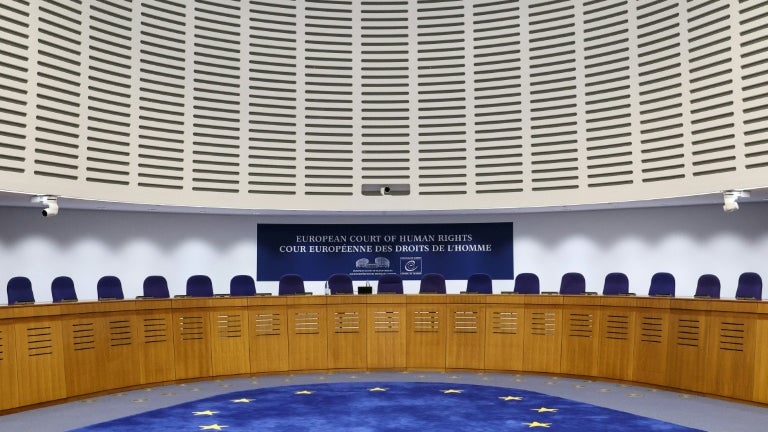
A technology that should not be overlooked. Already used in the judicial system, in particular for researching case law or as an aid in compiling a file, generative AI presents the European Court of Human Rights (ECHR) with "a new challenge", because it exposes it to an increased risk of abusive complaints, but can also speed up the processing of files, summarizes its president, Matthias Guyomar. “If we don’t use AI, we will be eaten.
We will be overwhelmed. And we will no longer be able to deliver justice,” he warns in an interview with AFP. “We know very well that tomorrow we can perhaps have, in one click, thousands of requests generated by artificial intelligence arriving at us,” he points out during this interview given on Wednesday, the anniversary of the signing of the European Convention on Human Rights in 1950, which the ECHR is responsible for applying in the 46 member countries.
It will then be necessary to be able to quickly detect if "the requests are abusive", continues Matthias Guyomar, highlighting the recent example of a complaint received "regarding a completely false, invented case". The phenomenon remains marginal, but “we expect it to increase”. And if they are valid, the Court will have to “handle this mass of cases”, underlines the Frenchman, appointed in May 2025 at the head of the institution for a three-year mandate.
Even though the institution is already overwhelmed by demands and is often criticized for the slowness of its procedures. Automation process in progress The ECHR, based in Strasbourg, is the body of last resort for individuals who believe that their rights have been violated, after exhausting all procedures in their country. Last year, the ECHR reduced it to 53.
450 the total of its pending cases, the lowest level in 20 years, thanks in particular to a 5% increase in cases judged. But this stock rose to more than 60,000 this year after an influx of requests, particularly from Turkey, in the wake of the repression after the 2016 coup attempt.
The Court has certainly initiated an automation process, with an internal tool which facilitates closed-circuit searches, and translation assistance. But, it is a question of going further and "seeing to what extent we can also do it in the more directly jurisdictional process", underlines the magistrate. Beforehand, the ECHR will develop an “ethical charter” whose adoption is planned for next year and which will be made public.
“There is a principle condition, which is that the human must remain in the loop. And that there is no question of delegating to the machine what is strictly within the order of judicial deliberation,” he decides. But this integration of AI will have a cost, and will therefore depend on the goodwill of member countries, even though the means are already lacking according to him.
Machine-translated from French
Not cross-checked yet
Only BFM Business reports this story so far. We show it as a single source until another newsroom confirms it.
- BFM Business6 Nov, 10:05
| Publisher BFM Business (established tier) | +76 |
| Detailed summary | +2 |
| Total | 78 |
Method: reports are grouped by the words of their headline and summary; each newsroom counts once; figures are read from the reports as published. Nothing here is written by an AI.