Chinese markets lose trillions as race for AI supremacy with US takes its toll
Lack of profits and the threat posed by western countries are raising concern about the sustainability of Beijing’s AI boom Trillions of dollars have been wiped from China’s stock markets in recent months amid…
Chinese markets lose trillions as race for AI supremacy with US takes its toll Lack of profits and the threat posed by western countries are raising concern about the sustainability of Beijing’s AI boom
Trillions of dollars have been wiped from China’s stock markets in recent months amid increasing anxiety about the future of artificial intelligence, as Beijing races against the United States for dominance in the sector.
The STAR 50 Index, which tracks technology and innovation companies on the Shanghai stock exchange, has plunged 40% since June. Other indexes of major companies dropped by about 20% over the same time period.
The precipitous drop has wiped out $2.4tn from the Chinese stock market since May, according to Bloomberg.
AI stocks account for over 40% of the stock market value in China and Hong Kong, according to Goldman Sachs, meaning that any dent in value will send shockwaves across the whole domestic market.
The fall suggests that despite the government’s best efforts to boost China’s technology industries, particularly those which harness the power of AI, the domestic economy does not have the power to sustain a booming market.
The Chinese government has invested heavily into AI, including a 60bn yuan state-backed AI investment fund which started pumping money into domestic developers this month. But Chinese consumers have proved stubbornly reluctant to part with their cash in many parts of the economy – including technology – meaning that many tech companies struggle to turn a profit.
The lack of profits is one of several reasons for the sell-off. Another is the threat of western countries, especially the US, extending bans on Chinese technology.
“This year, the profit margin is not as good as expected. And the US is raising rates. And China’s domestic demand is so weak,” said Dan Wang, the China director for the Eurasia Group. She said that there was a “general anxiety” among technology companies about whether or not the state-backed model would work in the face of weak consumer demand.
The US has banned humanoid robots from China , citing national security risks, and is thought to be considering a ban on Chinese components in data centres. China is heavily reliant on exports and restrictions in the US hurt its domestic companies, which struggle to sell enough products at home.
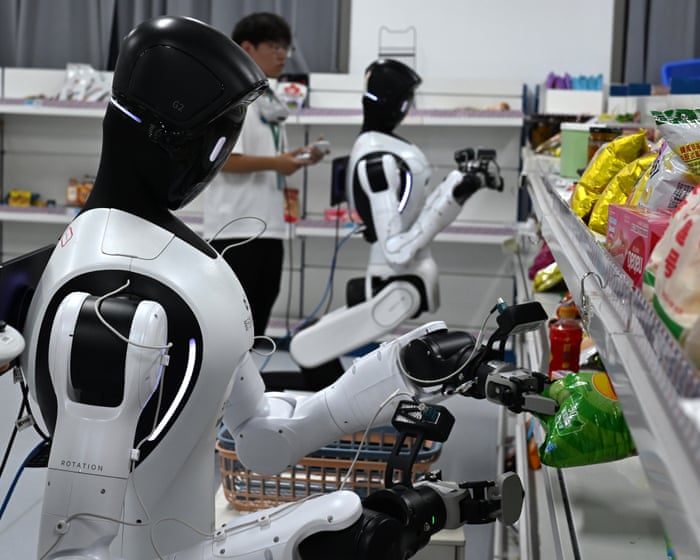
As China races with the US to pull ahead in AI, Beijing has doubled down on robotics – also known as embodied AI – as the key to rolling out the technology across society. Robotics is also seen as the answer to China’s demographic problems, such as the ageing population and the shrinking workforce.
But the demand for robotics is being driven by government agencies and research institutions, rather than everyday consumers, for whom the products are still too expensive and not yet practical for home use. Humanoid robotics and robotic dogs have been popular in the entertainment industry but are yet to be useful in home settings.
Not cross-checked yet
Only The Guardian reports this story so far. We show it as a single source until another newsroom confirms it.
- The Guardian27 Oct, 05:42
| Publisher The Guardian (reference tier) | +82 |
| Detailed summary | +2 |
| Total | 84 |
Method: reports are grouped by the words of their headline and summary; each newsroom counts once; figures are read from the reports as published. Nothing here is written by an AI.