“Like a tax increase to which voters did not agree”: the fuel surge has cost Americans more than $1,000 and Donald Trump risks paying dearly in the midterms
Economic issues and the cost of living top the concerns of American voters, ahead of very perilous mid-term elections for Donald Trump. While the surge in energy prices linked to the conflict with Iran weighs heavily…
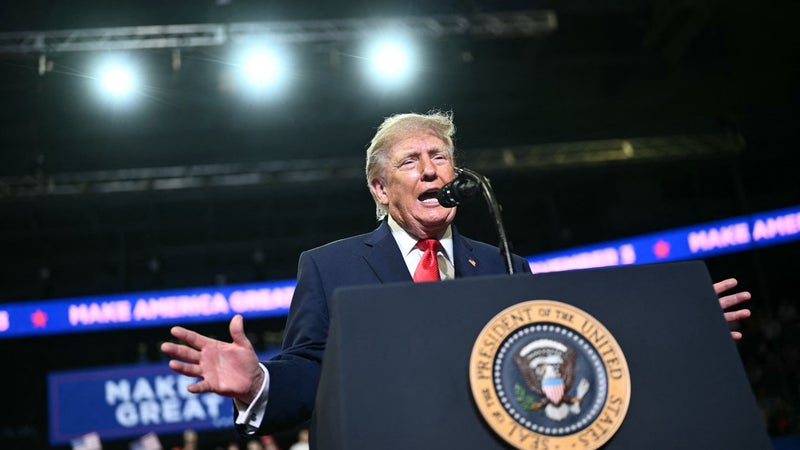
The economy and energy prices will be the first concern of the 210 million American voters called to the polls this Tuesday, November 3 for high-risk midterm elections for Donald Trump and the Republican Party. The entire House of Representatives and a third of the Senate seats are up for grabs. 84% of registered voters say the economy will be a determining factor in their vote, more than any other issue, according to the Pew Research Center, a research center specializing in opinion polls.
The offensive launched by Donald Trump and Benjamin Netanyahu against Iran has caused fuel prices to jump in the United States, leading the American president to take contested measures - such as the lifting of sanctions on Russian hydrocarbons - to try to calm prices at the pump, particularly in the electoral strongholds of the Republican Party, such as the Midwest. Since February 28, the pump price of a gallon of diesel (3.8 liters) - the fuel for tractors and trucks - has reached an all-time high, rising from $3.67 to $6.29, a jump of 71%. That of gasoline climbed 40%, to $4.17, approaching the peaks observed at the worst of the energy crisis of 2022, after the invasion of Ukraine.
This corresponds to a liter of diesel at 1.48 euros and a liter of gasoline at 0.98 euros, prices significantly lower than those on this side of the Atlantic (2.28 euros for diesel and 2.08 euros for SP-95). The difference is explained by the level of taxes and the fact that the United States is the largest oil producer on the planet. However, this outbreak must be put into perspective.
Once inflation is taken into account, prices at the pump remain below their record of July 2008, when a barrel of oil reached $148, on the eve of the financial crisis, recalls the Pew Research Center. “That month, the national average price of regular unleaded gasoline was $6.18 per gallon (in today's dollars) and that of diesel was $7.26 per gallon,” the research center adds. Concretely, it was necessary to work almost 7 hours at the median wage to fill up in July 2008*, compared to just over 4 hours in October 2026 (and 2 hours 43 minutes just before the war).
This historical precedent, however, risks being quite far from voters' considerations. Their memory of inflation generally only goes back 9 months before the election, according to a study by researchers at Chapman University. The same trap as Biden Donald Trump therefore finds himself faced with the same political risk as Joe Biden and the Democrats during the 2024 presidential election: seeing rising prices fuel voter discontent and turn against his camp at the polls.
Machine-translated from French
Not cross-checked yet
Only BFM Business reports this story so far. We show it as a single source until another newsroom confirms it.
- BFM Business3 Nov, 06:01
| Publisher BFM Business (established tier) | +76 |
| Detailed summary | +2 |
| Total | 78 |
Method: reports are grouped by the words of their headline and summary; each newsroom counts once; figures are read from the reports as published. Nothing here is written by an AI.