Is this the beginning of the end of the AI stock market boom?
After a wobble on the tech-heavy Nasdaq, some AI market observers think a reassessment of the potential value of various businesses may be under way Get our breaking news email , free app or daily news podcast The…
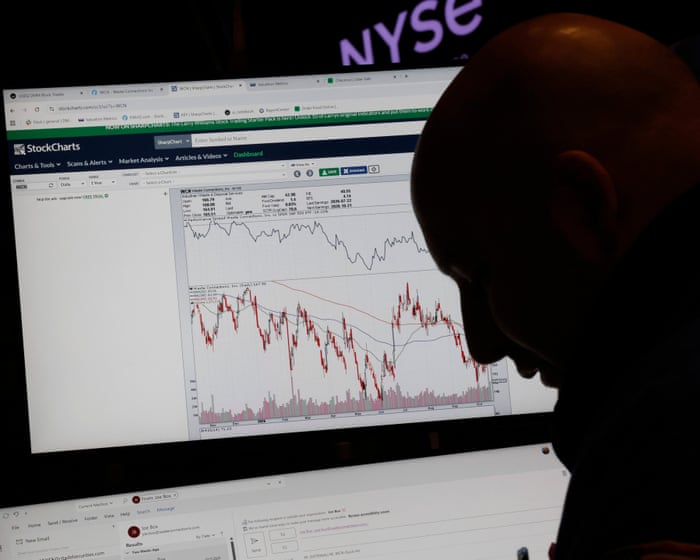
Analysis Is this the beginning of the end of the AI stock market boom? Patrick Commins After a wobble on the tech-heavy Nasdaq, some AI market observers think a reassessment of the potential value of various businesses may be under way
Get our breaking news email , free app or daily news podcast
The world is holding its breath as it waits to find out whether this year’s estimated $US1tn investment in artificial intelligence is resting on a castle made of sand.
Last week, the Nasdaq 100 – an index of the 100 biggest non-financial stocks on the American tech-heavy Nasdaq exchange – dropped by 5.5%, triggering the usual angst that the AI boom is about to go bust.
The recent rot may have started with the failure of Firmus, an Australian datacentre company, to list on the ASX.
The multi-billion dollar initial public offering was, at one stage, on track to make Firmus worth more than Telstra – even before having delivered on its promised earnings.
That proved to be a fever dream of its founders and a wake-up call to investors in Australia and around the world to reconsider the potential value of similar businesses.
If this is the beginning of the end of the AI boom, it is only the very beginning, and tech stocks bounced back in Wall Street trade on Monday night.
Gerard Minack, of Minack Advisors, said his view was that investors were fundamentally overestimating the returns that AI providers will be able to deliver.
“While I am becoming more confident that returns on AI investment will disappoint, I have no confidence calling the precise top of the AI market,” Minack said.
Despite the recent wobbles, the Nasdaq 100 is still worth nearly three times more than at the start of 2023.
On the S&P 500, meanwhile, tech titans Alphabet, Amazon, Apple, Meta, Microsoft, Nvidia and Tesla now account for 35% of the American sharemarket index, up from 12% a decade ago.
The total market capitalisation of the so called “magnificent seven” companies has increased by more than 50% in the past two years.
Raisah Rasid, a Singapore-based global market strategist at JP Morgan Asset Management, said what she was seeing in the recent sell-off was “a valuation reset, rather than the market questioning the efficacy of AI itself”.
“This is still a long-term, structural transformation trend,” Rasid said. “This is very different from the dotcom bubble.”
Rasid sees two potentially more meaningful threats. First, that an open source AI model, potentially from China, could undermine the economics of AI and the hundreds of billions of dollars of investment – a concern shared by Minack.
Not cross-checked yet
Only The Guardian reports this story so far. We show it as a single source until another newsroom confirms it.
- The Guardian20 Oct, 04:29
| Publisher The Guardian (reference tier) | +82 |
| Detailed summary | +2 |
| Total | 84 |
Method: reports are grouped by the words of their headline and summary; each newsroom counts once; figures are read from the reports as published. Nothing here is written by an AI.