Young people's concerns are "legitimate": Nobel Prize winner Stiglitz understands social movements in France, while defending pension reform
The economist, who actively campaigns for an increase in taxes on the ultra-rich, nevertheless considers it necessary for France and Europe to rethink "certain public spending".
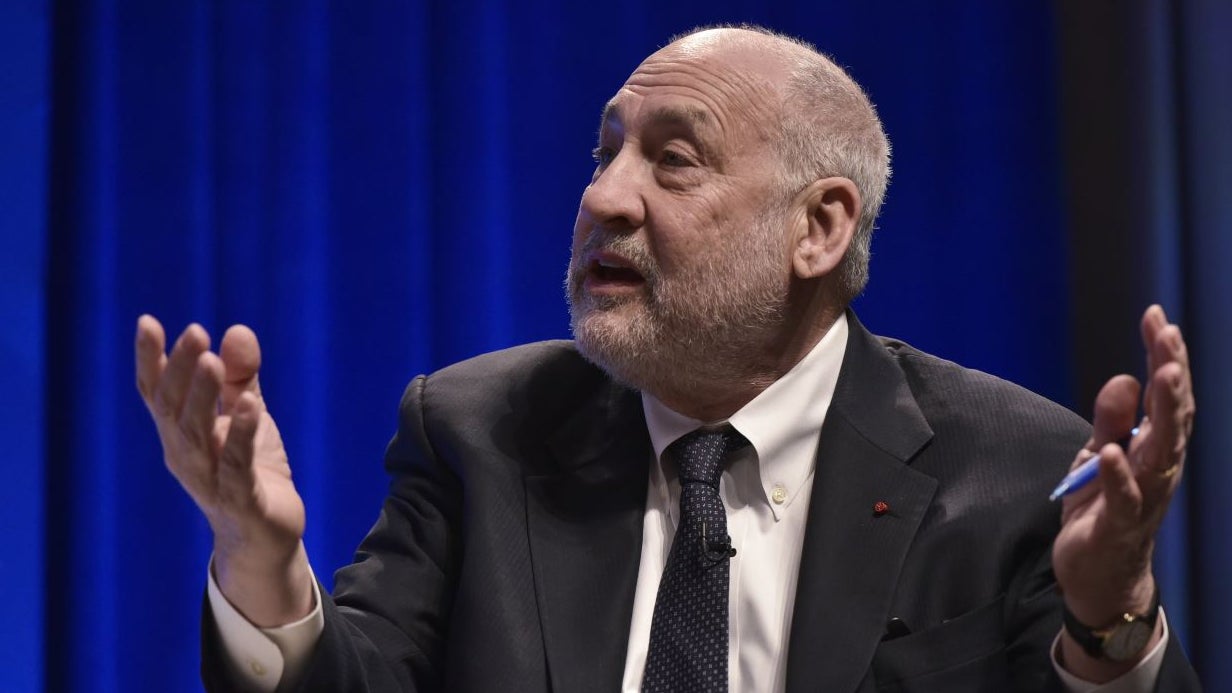
The demands of social movements carried out in particular by young people in France and in Europe against the rise in the cost of living are "legitimate", said Nobel Prize winner Joseph Stiglitz in economics on Thursday, pleading for a wealth tax in an interview with AFP. The mobilizations for purchasing power, which combine other demands such as additional means for education, have brought together hundreds of thousands of people across France every week since October 17. Demonstrations also took place in several European countries, such as Italy, and a call for “coordinated demonstrations” against the high cost of living was launched by unions and associations in seven countries for November 20, 21 and 22.
Inequality between generations "Part of the problem, in France in particular, but also in the Western world as a whole, is inequality between generations," declared Joseph Stiglitz on the sidelines of a meeting in Paris of the Independent Commission for the Reform of International Corporate Taxation (ICRICT) which he co-chairs. “Young people see that they are inheriting a world (marked by) climate change and environmental degradation. They struggle to access housing.
They do not benefit from the education that would enable them to realize their potential. Artificial intelligence raises new concerns,” continued the 83-year-old American economist, former chief economist of the World Bank and co-winner of the Nobel Prize in economics in 2001. “Low growth and increasing inequality mean that a significant part of the population will probably not be able to reach the standard of living of their parents or realize their aspirations,” he added.
"It's young people in particular who are protesting, and I think these are legitimate concerns (...) and that their diagnosis of the world that is left to them is not unreasonable." Taxing the wealth of the wealthiest Joseph Stiglitz actively campaigns for an increase in taxes on the ultra-rich to reduce inequalities.
He supports the establishment of a minimum tax of around 2% on high wealth, as proposed by economist Gabriel Zucman for fortunes above 100 million euros. The Nobel Prize winner will participate on Saturday in a summit in Paris "against the international oligarchy" organized at the initiative of the International Tax Observatory headed by Mr. Zucman.
He is also one of the signatories of a manifesto to be published on Friday for the establishment of an exceptional tax making it possible to regularize the "unpaid debts" of billionaires at a rate of around 25%. This would bring in some 250 billion euros in France. “Today, the wealth accumulated by the most fortunate is such that a low tax rate can generate considerable revenue,” argued Joseph Stiglitz.
To respond to demands while France has one of the highest public deficits in the euro zone, "there is room to increase public spending provided that tax revenues are also increased, a wealth tax could constitute a source of income", he underlined. Ideally, taxes on wealth and corporate profits should be introduced at the level of the European Union, "because free movement today facilitates tax optimization". “A more flexible pension system” The professor from Columbia University in New York, however, considered it necessary for France and Europe to “rethink certain public spending” while the continent seeks to strengthen its strategic autonomy vis-à-vis the United States.
“Students may not fully appreciate this reality. Demonstrators do not always understand that beyond the usual budgetary constraints, we are going through a particularly difficult period. This therefore implies a careful evaluation of the various public programs,” he explained.
He pleads in particular for "a more flexible and flexible pension system" where the increase in life expectancy would justify "working longer", while taking into account the arduousness of the work. Concerning California, where a proposed tax on the wealth of billionaires was rejected by referendum, Joseph Stiglitz regretted that “money undermines democracy” in the United States. In this American state, the most populous, "billionaires were ready to spend hundreds of millions of dollars to avoid paying their fair share of taxes", he lamented while the sum taken was to help finance the public health system.
Machine-translated from French
Why it is marked verified
2 independent newsrooms report this story. 20 Minutes published it first, 1 min before the last one.
- 20 Minutes19 Nov, 18:41
- BFM Business19 Nov, 18:43
| Publisher BFM Business (established tier) | +76 |
| Detailed summary | +2 |
| Carried by 2 newsrooms | +5 |
| Total | 83 |
Method: reports are grouped by the words of their headline and summary; each newsroom counts once; figures are read from the reports as published. Nothing here is written by an AI.