If Ivory Coast does nothing, its cocoa production could fall by 20% by 2050: the world's leading producer wants to develop varieties more resistant to climate change
In Ivory Coast, a country which concentrates 40% of global cocoa production, local producers suffer from a chronic lack of rain due to climate change. Researchers are developing more resistant varieties to preserve…
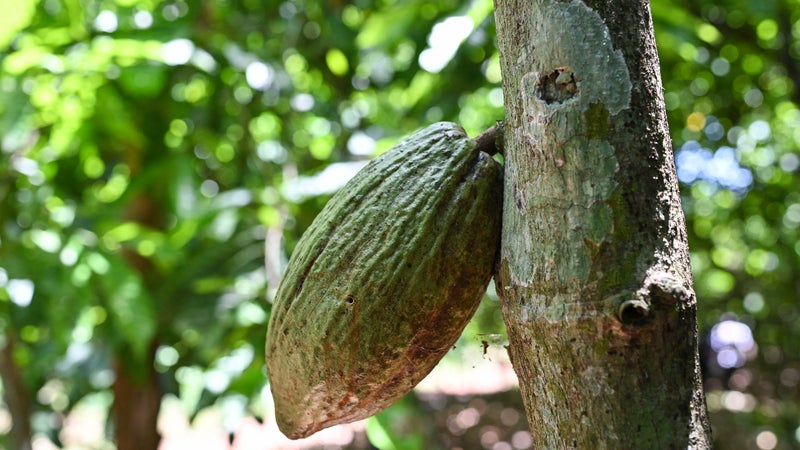
When it stops raining, "you can lose everything", sighs Koffi Alexis Amani, a cocoa producer whose plantations have withered several times under the effect of climate change in Ivory Coast, the world's leading producer of this brown gold. Like him, thousands of planters have seen their cocoa trees wither, sometimes die, since the rains are unpredictable, less abundant and temperatures rise in this West African country particularly vulnerable to climate change, despite its low contribution to global CO2 emissions. In this context, scientists from the National Center for Agronomic Research (CNRA) have created cocoa that is more resistant to water stress.
Because behind the climate issue there are important economic interests at play: the precious beans of Côte d'Ivoire represent 40% of world production and 15% of national GDP, and support a total of around five million people, directly and indirectly. Demand is growing, particularly in Europe, which concentrates 70% of Ivorian cocoa exports according to government data, has a large processing industry and remains the world's largest consumer of chocolate products. At one of the CNRA research stations, in Divo (in the south of Ivory Coast), scientists selected among the best known varieties of cocoa and tried different breeding combinations.
Less rain and less flowering "We take the flowers of the male parents which we pollinate on the flowers of the female parents (...) it is their offspring which is taken", tested "in a greenhouse" and subjected to different levels of water stress, explains geneticist Caudou Trebissou. At the same time, observations are carried out in the laboratory, in particular to find the origin of resistance to lack of water.
The CNRA has so far created 11 varieties, the results of which have been judged "satisfactory", so that they will one day be commercialized. Research on water resilience, begun in the 2010s, however, takes “time”, notes Caudou Trebissou. And the tests, on plantations or in the laboratory, are expensive.
According to the Ivorian Ministry of the Environment, which describes in a report a climate with "many fluctuations since the 1950s", "rainfall has been particularly poor since the 1980s". “From 2003 to 2022, we have seen that the rainfall has decreased. We are only at 1.
100 and a few millimeters of water on average per year in the region, instead of a quantity between 1,200 and 2,000 mm that cocoa trees need, specifies Maryse Assi, agronomist member of the CNRA research team.
When the plants manage to survive, “we have a drop in flowering or a delay” and “few fruits”, she adds. The lack of rain also creates "decreases in soil fertility, there will be mineral elements which will no longer be accessible to the plant", continues the researcher. Near Bouaflé, in the center of the country, Anselme Kouakou has seen his cocoa trees weaken in recent years.
Machine-translated from French
Not cross-checked yet
Only BFM Business reports this story so far. We show it as a single source until another newsroom confirms it.
- BFM Business31 Oct, 17:04
| Publisher BFM Business (established tier) | +76 |
| Checkable figures cited | +3 |
| Detailed summary | +2 |
| Total | 81 |
Method: reports are grouped by the words of their headline and summary; each newsroom counts once; figures are read from the reports as published. Nothing here is written by an AI.