“Quantity too small to exploit it”: Marine Le Pen wants to relaunch the search for oil in France, but Totalenergies’ latest drilling in Guyana has yielded nothing
Marine Le Pen wants to repeal the Hulot law to revive research and exploitation of hydrocarbons in France. However, the latest research carried out in Guyana by Totalenergies has proved unsuccessful.
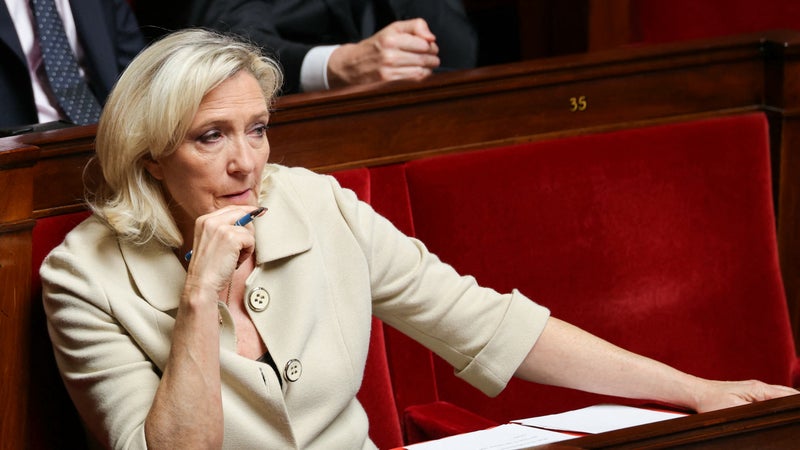
If she comes to power, Marine Le Pen promises to relaunch research and exploitation of hydrocarbons on French soil, by abolishing the Hulot law, adopted at the end of 2017 for environmental reasons. "We will abolish, for example, the stupid Hulot law which prohibits the search for hydrocarbons on French soil", launched Marine Le Pen on Sunday during her first campaign meeting, in Orléans, in an elaboration on the "power" that the candidate promises to return to France, in order to break "with the logic of decline". This law passed by Nicolas Hulot, when he was Minister of the Environment, prohibited the issuance of new research permits as well as the renewal of existing concessions on French territory, on land and at sea, beyond 2040.
In 2024, 64 oil and gas fields were still active (mainly in the Aquitaine basin and the Paris basin), but they only represented around 1% of national consumption. France therefore imports most of the hydrocarbons consumed, which costs it around 50 billion euros per year. If France does not produce more, it is because it does not currently have significant and proven oil reserves, and its main gas deposit, located in Lacq (Pyrénées-Atlantiques), is considered exhausted.
Marine Le Pen would, however, like to relaunch the exploration. She's not the only one. In 2025, Manuel Valls, then Minister of Overseas Affairs, said he wanted to "open the debate" and this measure is also demanded by overseas elected officials.
A bill, carried by Guyanese senator Georges Patient, was tabled at the end of 2025 to repeal the Hulot law overseas, particularly in Mayotte and especially in Guyana. Approved by the Senate, it was however rejected in June by the Assembly. The attraction of the oil boom in Guyana and Suriname In Guyana, research was stopped in 2019 for lack of convincing results.
The search for possible oil deposits, however, remains a recurring subject, while significant reserves have been found on both sides of the department, under the Atlantic Ocean, in what specialists call the "equatorial margin". Considerable deposits were notably discovered in neighboring Guyana and Suriname in the 2010s. In Guyana, a small independent country of 840.
000 inhabitants, reserves are estimated at 11 billion barrels, more than in Norway for example. While oil production has already reached 900,000 barrels of oil per day, the country's growth has soared (+19.3% in 2025), making it possible to quadruple the state budget in five years.
At the same time, the Brazilian company Petrobras recently announced that it had found oil east of Guyana, in Brazilian waters, paving the way for a major exploitation project supported by President Lula. The reasoning of certain Guyanese elected officials is therefore simple: if there is oil in the west and the east, there must also be some in Guyana, and its exploitation would be welcome, while more than half of the population lives below the poverty line, according to INSEE figures. Total no longer wants to search in Guyana Except that the research carried out by Totalenergies has so far been unsuccessful.
Machine-translated from French
Not cross-checked yet
Only BFM Business reports this story so far. We show it as a single source until another newsroom confirms it.
- BFM Business28 Oct, 05:56
| Publisher BFM Business (established tier) | +76 |
| Detailed summary | +2 |
| Total | 78 |
Method: reports are grouped by the words of their headline and summary; each newsroom counts once; figures are read from the reports as published. Nothing here is written by an AI.