US military gives Elon Musk’s SpaceX access to sensitive tracking data
This gives the company an advantage in tracking objects in orbit, raising national security concerns and fears of greater control over the space industry The US military has given Elon Musk’s SpaceX access to…
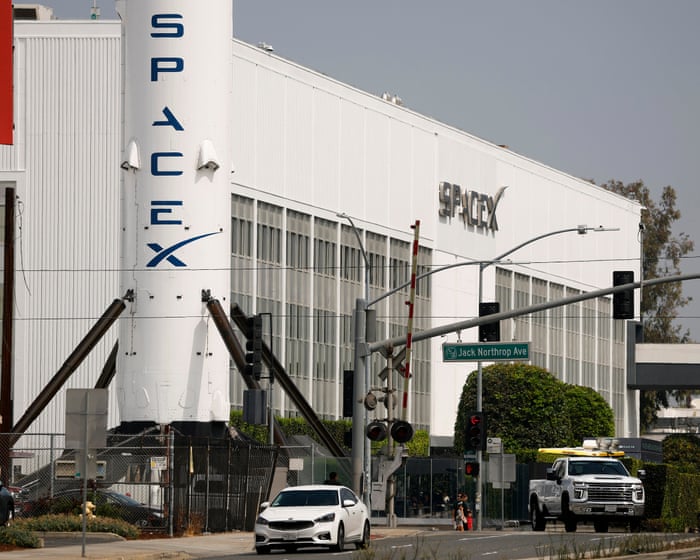
US military gives Elon Musk’s SpaceX access to sensitive tracking data This gives the company an advantage in tracking objects in orbit, raising national security concerns and fears of greater control over the space industry
The US military has given Elon Musk’s SpaceX access to restricted space tracking data, raising a new round of questions about whether the Trump administration is attempting to hand over traffic control in Earth’s orbit to a controversial donor.
The access also raises new national security questions, industry observers say.
The move comes after Musk’s Doge in 2025 fired many of the federal government’s nascent space traffic control program’s staff, and the administration has twice attempted to financially gut the department, called the Traffic Coordination System for Space (Traccs).
The moves were widely viewed in the industry as an attempt by Musk to privatize space traffic control. The defense department has now granted SpaceX access to its most precise data on potential collisions among satellites and other space objects, which will give Musk’s companies an advantage over competition that offers a similar service.
SpaceX and the Space Force signed the new contract. The commercial US space market is expected to grow to a value of nearly $2tn in value over the next decade, and the unprecedented access to military data appears to be another step toward Musk asserting monopoly control over commercial space activity more broadly, said Cole Donovan, a former Traccs employee now with the Stand Up for Science non-profit.
“It’s making a company the de facto source for space traffic coordination within the US,” Donovan added. “It’s like giving a trucking company control of all the traffic lights, which they can switch to red whenever it’s their competition’s turn to go.”
Traccs manages thousands of satellites, debris and spacecraft, and helps prevent up to 50,000 near-collisions, called conjunctions, daily.
SpaceX and Space Force did not respond to requests for comment from the Guardian, but in a statement to Breaking Defense acknowledged the move.
“The Space Force is engaging with several companies to exchange commercial data sources for access to sections of the controlled, unclassified information, high accuracy catalogue, where it provides benefit to the US government,” a spokesperson told the outlet.
SpaceX has been expanding its power over launch and other space services, while growing closer links with the US government. Multiple industry observers have said since the Trump administration took over that they fear a “vendor lock” scenario in which the government is overly reliant on SpaceX because it has such immense influence and is so technologically advanced.
Not cross-checked yet
Only The Guardian reports this story so far. We show it as a single source until another newsroom confirms it.
- The Guardian25 Oct, 13:00
| Publisher The Guardian (reference tier) | +82 |
| Detailed summary | +2 |
| Total | 84 |
Method: reports are grouped by the words of their headline and summary; each newsroom counts once; figures are read from the reports as published. Nothing here is written by an AI.