UK looking to give carmakers incentives to turn EVs into ‘power plants on wheels’
V2G tech enables drivers to charge automatically when electricity is cheaper and then sell some back to the grid at times of high demand Business live – latest updates Electric cars that can be used as “power plants on…
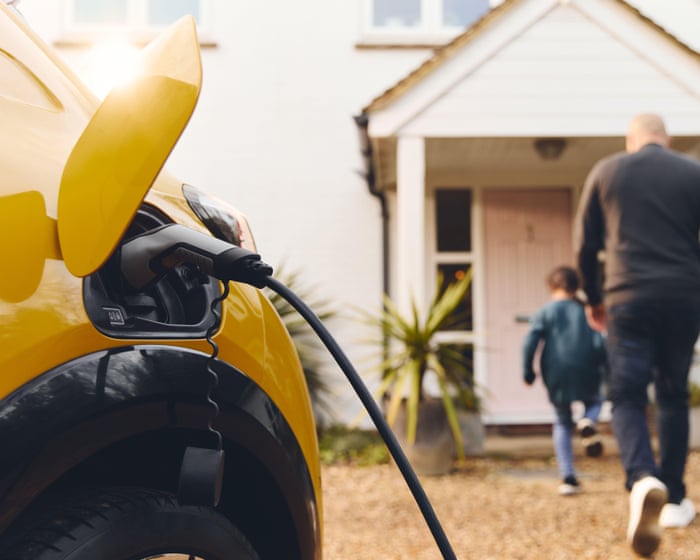
UK looking to give carmakers incentives to turn EVs into ‘power plants on wheels’ V2G tech enables drivers to charge automatically when electricity is cheaper and then sell some back to the grid at times of high demand
Electric cars that can be used as “power plants on wheels” could be given government backing as part of plans under consideration to help UK manufacturers.
Ministers are considering giving manufacturers incentives to add “vehicle to grid” (V2G) technology to cars as part of its review of the zero-emission vehicle (ZEV) mandate.
The technology allows drivers to charge automatically when electricity is cheap overnight, and then sell some of it back to the grid at times of high demand.
If millions of cars have the ability to send power back – or power the driver’s home (V2H) – it could help to solve one of the big problems of the transition away from fossil fuels to renewables: how to balance the grid during still, cloudy or dark periods when wind and solar generation is lower than electricity demand.
The move could give incentives to help to spread a technology that is not yet widely used, but which could lessen the load on the grid and the need to fire up expensive gas power plants to fill gaps in supply. Home batteries can do the same job .
Smart charging tariffs, which do not need V2G tech, already help with the opposite problem by encouraging electric vehicle (EV) owners to charge up when electricity is overabundant and cheap – reducing the need to pay renewable generators to switch off .
However, campaign groups said the ZEV incentives could also have the perverse effect of allowing carmakers to sell more polluting petrol models in the next few years.
Carmakers could earn a “credit” for selling cars installed with V2G technology, also known as bidirectional charging , according to plans detailed in a government consultation that closed on Friday. That credit would allow the carmakers to sell another petrol car without facing the risk of fines if they miss the ZEV targets.
The government is preparing to cut electric vehicle sales targets under the ZEV mandate. Environmental groups are braced for changes that could mean an additional 147m tonnes of carbon emitted into the atmosphere by 2050.
Ben Nelmes, the chief executive of New AutoMotive, a thinktank tracking the transition to electric cars, said: “Vehicle to grid is exciting technology that could help balance the grid and cut bills, but carmakers should only be rewarded if it’s actually used, not just for fitting it.
“Under these proposals, one or even two extra credits worth around £4,000 each would hand manufacturers thousands per car for kit that costs a few hundred pounds, even though few drivers own the expensive charger needed to use it. Ministers should make sure the people who benefit from V2G are drivers and billpayers, not carmakers’ shareholders.”
Not cross-checked yet
Only The Guardian reports this story so far. We show it as a single source until another newsroom confirms it.
- The Guardian26 Oct, 14:00
| Publisher The Guardian (reference tier) | +82 |
| Detailed summary | +2 |
| Total | 84 |
Method: reports are grouped by the words of their headline and summary; each newsroom counts once; figures are read from the reports as published. Nothing here is written by an AI.