“The closest association ever concluded”: the EU and Canada seal an unprecedented rapprochement and will collaborate in particular on Ukraine, critical minerals, AI or Erasmus
The European Union and Canada are strengthening their strategic alliance in critical minerals, artificial intelligence and the defense of their economic sovereignty. A rapprochement accelerated by tensions with…
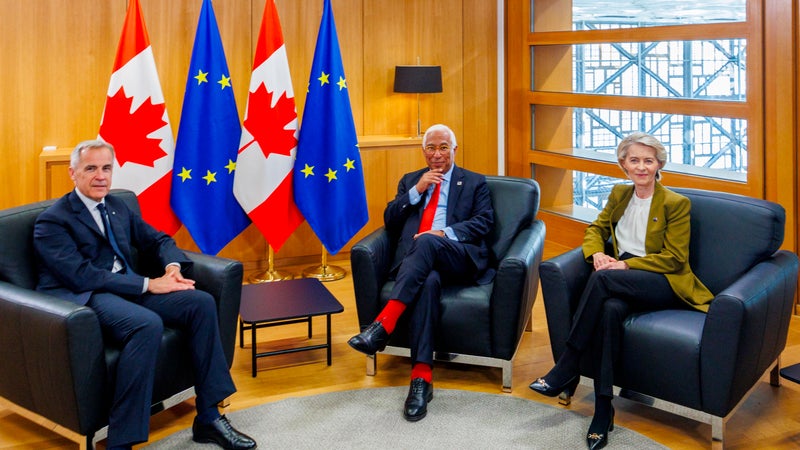
The European Union and Canada sealed on Friday the "closest alliance ever concluded" between a non-European country and the EU, including increased cooperation in strategic areas such as critical minerals or artificial intelligence. A strong symbol, Canada has also announced its intention to participate in the 90 billion euro loan granted by the EU to Ukraine. Thanks to this alliance, “Canada and the EU will be better equipped to meet common global challenges,” indicates the joint declaration published at the end of the summit.
This alliance is synonymous with “sovereignty”, “greater resilience” and must allow the two partners to “resist shocks together” in a world dominated by the United States and China, said Canadian Prime Minister Mark Carney. The EU and Canada (already linked for ten years by a free trade treaty, CETA) have accelerated their rapprochement since the return to power in early 2025 of American President Donald Trump, with whom their relations have been stormy. “The closest association ever concluded” But the summit organized Thursday and Friday in Montreal allowed them to go much further by building “the closest, deepest and most solid association ever concluded between the European Union and a non-European country.
Canada is by far the most European country among non-European countries", insisted the President of the European Council Antonio Costa. The EU and Canada have signed a series of agreements to extend their cooperation to several strategic sectors, from artificial intelligence to critical minerals. The Canadian subsoil is indeed full of these minerals which European industry, dependent on China, has a vital need for, particularly in the manufacturing of electric car batteries or wind turbines.
But Canada, which wants to reduce its dependence on the United States, needs to attract investors to accelerate the launch of mining projects. An agreement signed on Friday will allow the European Investment Bank (EIB) to finance it. A “union” in AI and digital technology The EU and Canada will also work together on AI in an attempt to defend their sovereignty against the domination of the United States and China in this area.
Concretely, Canadian researchers and companies will be able to have access to the European infrastructure of cutting-edge supercomputers to help them develop sovereign and secure AI systems. Canada announced Thursday that it was investing one billion euros in the Canadian AI company Cohere, already allied with the German Aleph Alpha, which makes it, according to Mr. Carney, "a concrete example of what Canada and Europe can build together."
“We are not going to wait for the future of AI to be decided elsewhere by people we do not know or whom we do not trust,” insisted the Canadian Prime Minister. Other agreements were revealed on digital commerce, allowing faster and less expensive online transactions, or on Canada's future integration or participation in several European programs such as Galileo, a satellite navigation system which offers an alternative to the American GPS system, or Erasmus, a European youth mobility system which notably allows students to spend a semester abroad. “Benefits” for Washington Strengthening the partnership between the EU and Canada must also involve an alignment of their policies on artificial intelligence or climate and a regular cooperation framework between their respective parliaments, executives and courts.
Machine-translated from French
Not cross-checked yet
Only BFM Business reports this story so far. We show it as a single source until another newsroom confirms it.
- BFM Business30 Oct, 18:14
| Publisher BFM Business (established tier) | +76 |
| Detailed summary | +2 |
| Total | 78 |
Method: reports are grouped by the words of their headline and summary; each newsroom counts once; figures are read from the reports as published. Nothing here is written by an AI.