They fear that Marine Le Pen will cut everything if she is elected: renewable energy developers are rushing for public contracts before the presidential election
Fearing that Marine Le Pen will put a stop to new wind and solar projects if she wins the presidential election, French renewable energy developers are rushing to land state-guaranteed contracts. An increase in supply…
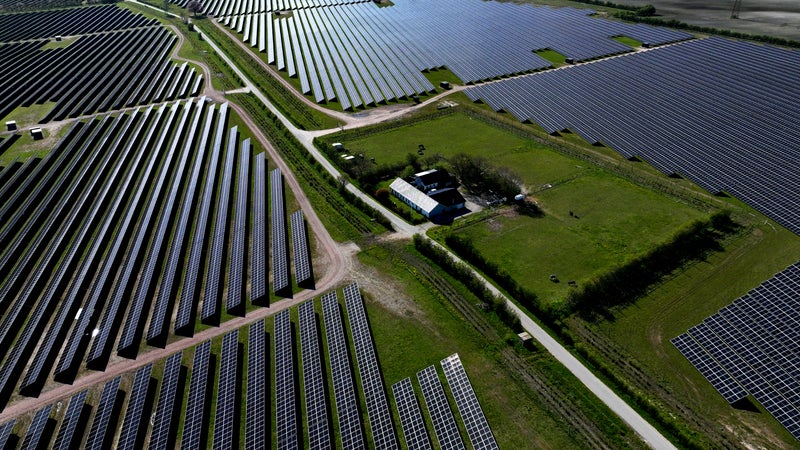
Is this the final stretch for French developers in the renewable energy sector? In any case, this is what the latter's rush to obtain contracts guaranteed by the state suggests, reports Bloomberg. In question, the recent polls which give Marine Le Pen well in the lead before the presidential elections.
The latter pledged to put an end to new wind and solar projects and criticized the billions of euros that France devotes to supporting renewable energies. Fearing a risk of freezing new projects, developers (who carry out projects to build wind turbines or photovoltaic panels) are engaged in a fierce battle before the deadline. In France the process is regulated: the State offers contracts and they position themselves.
Ainis, the latest auction dedicated to large solar parks recorded almost six times more bids than available places. Concretely, the candidates offer a price, and as there are many of them in competition, this encourages them to offer the lowest price. The selected candidates, including EDF and Reden Solar, have committed to selling electricity at prices 23% lower on average than those in last year's call for tenders.
An auction dedicated to smaller projects also saw its number of subscriptions explode, which caused prices to fall by 15%. Sector gloom Investors accept price levels "that remain attractive, before possibly having to face a period without calls for tenders", said Frank Demaille, managing director of Reden, which won 20% of the 931 megawatts awarded in the call for tenders for ground-mounted solar parks earlier this month. These price cuts add to the sluggishness of the sector, which is already carrying out job cuts and cost reductions after years of rapid expansion.
“This is putting pressure on our development and construction margins,” worries Thomas de Moussac, managing director and co-founder of Mexens SAS, one of the contract winners during the last call for tenders. Avoiding overproduction Inspired by Donald Trump's strategy, Marine Le Pen has been attacking the renewable energy sector for years, blaming subsidies – which exceeded 6 billion euros last year – as well as Emmanuel Macron's global energy policy for impoverishing the French and ruining the economy. French solar capacity has grown rapidly under Emmanuel Macron's presidency, after Russia's invasion of Ukraine sent energy prices to record levels in 2022, while technical problems sharply reduced nuclear production in France.
The context has since changed. Electricity demand remains moderate, renewable energy production has increased and EDF reactors have returned to service, prompting the government to lower some of its green energy targets in order to avoid overproduction. This turnaround is now having repercussions across the entire sector.
Projects that could generate revenue for the state In the last call for tenders, large solar projects obtained contracts at an average price of 61 euros per megawatt hour, which roughly corresponds to the level of wholesale contracts for 2029 and 2030 on the European Energy Exchange. The government pays aid to developers when market prices fall below this threshold, while companies pay a contribution to the state when prices exceed it. With such low prices, these projects could therefore require little or no subsidy if prices remain at levels close to current ones, and could even generate revenue for the state if they increase.
Machine-translated from French
Not cross-checked yet
Only BFM Business reports this story so far. We show it as a single source until another newsroom confirms it.
- BFM Business27 Oct, 12:56
| Publisher BFM Business (established tier) | +76 |
| Detailed summary | +2 |
| Total | 78 |
Method: reports are grouped by the words of their headline and summary; each newsroom counts once; figures are read from the reports as published. Nothing here is written by an AI.