‘Democrats need to not blow it’: our panel reacts to the historic midterms
Democrats should take the right lessons from their great night – but will they? Trump has been a disaster for our country. His economic plans are incoherent, the Iran war is making inflation worse, and his complicity…
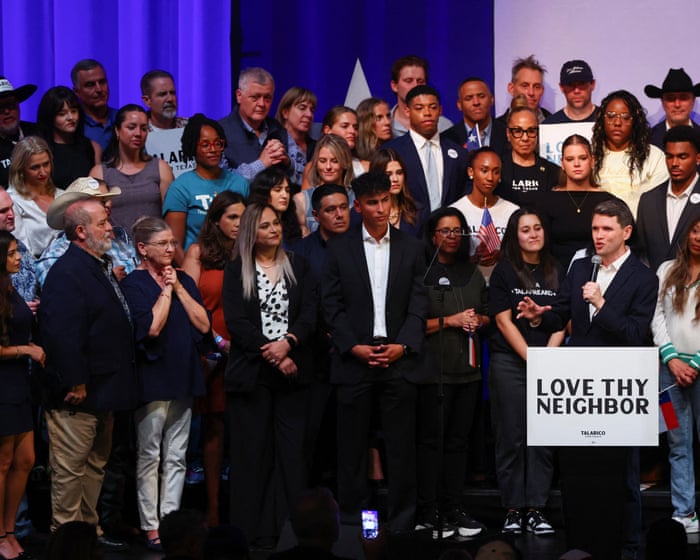
‘Democrats need to not blow it’: our panel reacts to the historic midterms Bhaskar Sunkara , Osita Nwanevu , Moustafa Bayoumi , Dustin Guastella , Kate Aronoff and Jill Filipovic Democrats should take the right lessons from their great night – but will they?
Trump has been a disaster for our country. His economic plans are incoherent, the Iran war is making inflation worse, and his complicity with Israel’s crimes in Gaza and other acts of lawlessness, from the extrajudicial killings in the Caribbean to the kidnapping of Maduro, have been combined with a continuing coarsening of American culture.
We live in a country with more casual racism, with more speculation and moral depravity, more selfishness than at any point in the recent past, and the rot starts in the White House with a man who’s the personification of vice.
Voters are making him pay. But the fact that even a victory like this leaves Republicans with so much support tells us about the extreme polarization of the country and the limits on how much electoral punishment a disastrous administration can expect.
To break through, Democrats need to do better in rural and semi-rural areas, and they need to reverse the trend of class dealignment in a more systematic way by making their party the party of working-class concerns and interests. That means fighting for higher wages, stronger unions, affordable housing and healthcare, and giving working people a reason to believe that Democrats will make their lives better.
They can’t rely on having Trump gift them elections through his erratic rule. A normal Republican administration can be almost as dangerous to working-class interests but will present nowhere near these opportunities. Democrats need to give voters something to support beyond their opposition to the man in the White House.
Fundamentally, we need a durable popular supermajority for progressive change in this country. And we need a wider coalition to do that. Winning back the House and Senate gives Democrats an opportunity to build it. But I have no confidence they’ll even attempt to build one.
Bhaskar Sunkara is the president of the Nation, the founding editor Jacobin, and the author of The Socialist Manifesto: The Case for Radical Politics in An Era of Extreme Inequalities
It hasn’t been at the front of most minds as the results have come in, but one of the biggest victors of the night has been the polling industry.
For a decade, since Donald Trump’s surprise victory in 2016, the field of opinion research has been placed under a tremendous amount of scrutiny – partly as a consequence of misses that suggest pollsters have systematically been undercounting Trump supporters.
Those critiques pointed to real challenges facing survey science but also an underlying anxiety – that Trump and Republicans under him have been able to defy gravity thanks to a standing reserve of disaffected, previously marginal voters willing to show up and back the right through thick and thin. Given that, the wild margins predicted for Democrats ahead of tonight couldn’t possibly have been real.
Well, they were. An ailing economy and high prices, an idiotic war abroad, a war being waged, here at home, against American cities and immigrant families that in no way resemble the criminals and vagrants the right has been ranting and raving about for years, naked corruption in Washington in the service of adding filigrees to the president’s fascism – these things did mater, it turns out, even to voters who’ve been willing to give the Trump circus multiple chances at the ballot.
A blue Texas would have set the mind reeling at the extent of the backlash alone – what’s happened on top of that is the most consequential midterm result in decades, big enough that this is already being discussed as a realignment election.
But a realignment to what? The majorities Democrats have won comprise candidates on both sides of the party’s internal divide – both the left and the center will have victories and near misses to crow about and parse.
The question of where the party should go in the broadest sense will remain unanswered in all of this; it’s not altogether obvious how Democrats will collectively decide to handle even the next two years of this administration, pulled, as they’ll inevitably be, between camps rightly demanding a crusade against Trump and rightly insisting that Democrats will need to prove to voters that they are attentive to the policy concerns that sent so many voters their way.
It will take bold, but shrewd political leadership to bridge those two tasks. We’ll find out very soon if there’s any of that to spare in the freshman class.
The Democrats swept Tuesday’s midterm elections, and the Republican party has no one but itself – and its leader – to blame.
Democrats took the House, winning seats that had been blood-red just two years ago. They took the Senate, grabbing formerly Republican seats in the Republican strongholds of South Carolina, Texas, Kansas, Ohio and Iowa, all states Trump won in 2024 with significant margins.
Voters didn’t seem to be particularly enamored with the Democratic candidates. They did, however, seem fed up with Republicans.
And who can blame them? As they worried about the cost of gas and ground beef, Trump obsessed over his new ballroom and the presence of algae in the reflecting pool.
Many people who voted for Trump did so in part because he promised to bring prices down and to refuse to enmesh America in messy wars in the Middle East; he has instead decided to go to war with Iran, which has sent prices skyrocketing at the pump.
While Americans on the left and the right have made clear that they don’t want datacenters in their backyards, those AI behemoths have been built anyway, even in the face of intense community opposition – and Trump has essentially told people to get over it.
The Republican party talks about “freedom” and scaremongers about Muslims taking away the rights of Americans, and yet across a significant chunk of the country, women can no longer get safe abortions – largely thanks to conservative Christians.
As Americans see their real spending power decrease, the Trump family and friends have used their power to make billions in corrupt deals.
There were, of course, some very bad Republican candidates in the race. From Lindsay Graham’s unqualified sister in South Carolina to the charisma-vacuum Ken Paxton in Texas; and Georgia’s Mike Collins.
And there were some excellent Democratic ones: the competent doctor Annie Andrews in South Carolina; the let’s-all-get-along seminarian James Talarico in Texas; the future president Jon Ossoff in Georgia.
But while candidate quality may have taken Democrats across home plate in some of America’s reddest states, it was Trump who got them to third base.
And as Republicans consider their party’s future two years from now when Trump is leaving office for good, they should take this as a clear lesson – the president has made their brand toxic. They should do their best to excise him from their systems now.
Republicans used to have a saying – that a government big enough to give you everything you want is a government big enough to take from you everything you have. It turns out that this saying applies equally to Donald Trump.
In 2024, Republicans gave Trump unprecedented and almost dictatorial control over the party, and he delivered victory on a scale that suggested populist majorities for decades to come. But returned to the White House without any restraints on his worst instincts, Trump brought misery to his working-class base through tariffs and the kind of forever war in the Middle East he had specifically promised to avoid. Now he has almost singlehandedly led the party into its worst defeat since perhaps the 1930s.
Unfortunately for the country, the Democrats’ victory was impressive in its dominance yet unlikely to determine the future direction of either party.
Both moderate and leftwing Democrats will claim that their victories showed why their faction should lead the party, and they seem likelier to spend as much time attacking each other as trying to find solutions to the country’s political dysfunctions and broken institutions.
Trump, who cares nothing about the party he leads, will punish any Republican who dissents from his ruinous and erratic course.
In any case, the Republican party has no positive program, only the negative hope that voters who are perpetually frustrated with the party in power will turn against the Democratic Congress in 2028. The 2026 midterms were a political earthquake but not a political realignment.
Geoffrey Kabaservice is research director of the Republican Main Street Partnership. He is also the author of Rule and Ruin
I’m referring of course to the so-called Trump dividend , where the president promised every adult voter a cool $5,000 if the Republicans held on to both the Senate and the House. Who knows how many people believed him, but the election results are now in. These midterm elections are a total and complete repudiation of the Trump agenda.
Not that Trump didn’t try to control the outcome of these elections from the get-go. He was behind the move to gerrymander election districts to be favorable to him across the country. He pushed to weaken key elements of the Voting Rights Act. He sought to have the federal government “take over” running the midterm elections from the states by “ nationalizing ” the elections. He tried to change the rules for voter registration , and he sought to destroy mail-in voting .
And yet, it didn’t work. This midterm elections prove that maybe it’s not so easy to manipulate American democracy, after all. (Some gerrymandered districts still went for the Democrats! ) This fact is a huge relief, especially under the historic failures of years of Maga politics.
But this election also brings extraordinary responsibility to the Democrats. And yet, this is a party that seems far too comfortable in being perpetually divided over what it believes in beyond being anti-Trump. Impeachment hearings alone do not constitute a political agenda.
The next few months may witness some (hopefully non-violent) tumult, as Trump may challenge the certification of some elections and exaggerate both noncitizen voting and voter fraud. And Trump, who excels in blaming others for his own failures, will no doubt now exploit Democratic control over Congress as the reason for all his future failures.
Not cross-checked yet
Only The Guardian reports this story so far. We show it as a single source until another newsroom confirms it.
- The Guardian4 Nov, 07:30
| Publisher The Guardian (reference tier) | +82 |
| Detailed summary | +2 |
| Total | 84 |
Method: reports are grouped by the words of their headline and summary; each newsroom counts once; figures are read from the reports as published. Nothing here is written by an AI.