INFOGRAPHICS. 446 million dollars for Musk, nearly 200 million for sports betting… Between billionaires, companies and small donors, who is really financing the battle of the midterms?
As the midterm elections of November 3, 2026 approach, dollars are raining down on the American campaigns. Between billionaires, tech giants, “Super PACs” and small donors, a behind-the-scenes look at electoral…
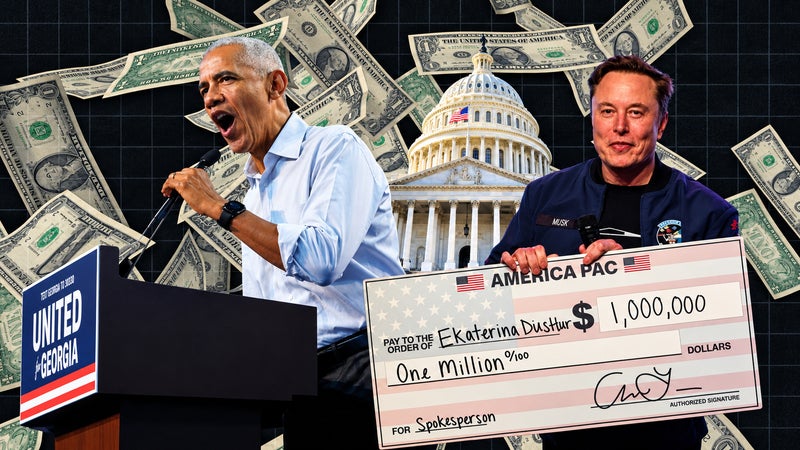
American elections are often a big money affair. Across the Atlantic, the colossal sums involved in campaigns for the presidency, the Senate or the House of Representatives would make the campaign accounts of many political leaders around the world pale. In the United States, these “inordinate sums” are an essential part of the electoral battle, whether it involves financing advertising campaigns, meetings, travel, polls or even field teams.
The 2024 presidential election provided a new illustration of this. According to OpenSecrets, a leading organization in monitoring American political financing, electoral spending reached a record amount of 15.9 billion dollars (approximately 14.5 billion euros), taking into account both the race for the White House and the legislative elections. Donald Trump and Kamala Harris alone spent nearly $2.6 billion on advertising between March and November 2024: $1.6 billion for the Democratic candidate and $993 million for her Republican rival.
The next American elections, the midterm elections, scheduled for November 3, 2026, are also expected to mobilize considerable sums. According to public data from the Federal Election Commission (FEC), the top 50 donors and organizations have already contributed $2.77 billion to the 2026 election cycle. Contributors close to the Republican Party represent $1.67 billion, or about 60% of the total, compared to $832 million (30%) for those close to the Democrats.
The remaining $264 million (10%) comes from donors who can be classified as bipartisan or representing special interests, notably in the sports betting and cryptocurrency industries. In total, nearly $11.6 billion is expected to be spent by Election Day. This explosion in spending is largely explained by the growing role of "Super PACs" (independent political action committees, editor's note), which allow wealthy people and corporations to finance electoral campaigns without ceilings on donations, provided they do not coordinate directly with the candidates.
The Republicans rely on their mega-donors, the Democrats on small patrons According to data from OpenSecrets and Ballotpedia, two American non-profit and non-partisan organizations specializing in monitoring the financing and organization of elections, the weight of these structures has continued to increase. Between the 2016 presidential election and that of 2024, the sums collected by Super PACs were multiplied by almost three, exceeding the threshold of 5 billion dollars for the first time. Long in the minority in electoral financing, these committees now represent nearly a third of all expenses incurred during American presidential and legislative elections.
Behind these amounts there is also a different sociology of donations between the two major parties: on the one hand, the weight of billionaires and large fortunes, on the other, that of small contributors, who also participate in financing campaigns. Democratic campaigns have dominated fundraising from small donors this election cycle, raising four times as much as Republicans ahead of the Nov. 3 midterm elections, according to a Washington Post analysis of federal fundraising data. The Democratic campaigns for the House and Senate reported receiving about $574 million in cumulative donations under $200, according to fundraising data, compared to "only" $143 million for Republican committees.
Machine-translated from French
Not cross-checked yet
Only BFM Business reports this story so far. We show it as a single source until another newsroom confirms it.
- BFM Business2 Nov, 05:56
| Publisher BFM Business (established tier) | +76 |
| Detailed summary | +2 |
| Total | 78 |
Method: reports are grouped by the words of their headline and summary; each newsroom counts once; figures are read from the reports as published. Nothing here is written by an AI.