‘It’s not a birthright’: Bristol Myers Squibb CEO warns America about vaccines and losing its measles elimination
On the day the U.S. lost its measles-elimination status, BMS CEO Chris Boerner warned against “policies that don’t” protect the drug ecosystem.
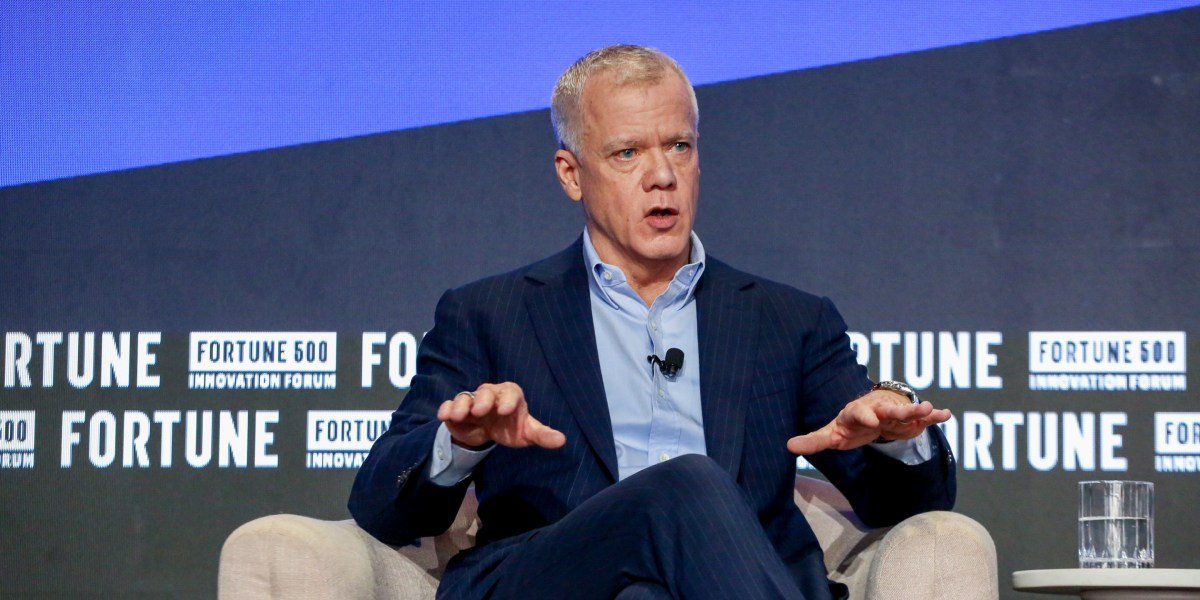
On the day the U.S. officially lost its measles-elimination status, Bristol Myers Squibb CEO Chris Boerner had a warning for the country that went beyond one virus.
“It’s a reminder,” Boerner said Tuesday at the Fortune 500 Innovation Forum in Detroit, after Fortune ’s Diane Brady opened their conversation with the news. The U.S. leads the world in new medicines, he said: 90% of them launch here, often two to three years before other rich countries get them. “That’s a real benefit that we have, but it’s not a birthright.”
On Tuesday, the Pan American Health Organization said the U.S. no longer meets the standard it first cleared in 2000: no single chain of measles transmission lasting 12 months or longer. The CDC has counted more than 5,400 cases so far in 2026, after 2,289 last year, many of them in outbreaks that began in close-knit Mennonite communities and spread, CBS News reported . Mexico and Bolivia lost their status too. Canada lost its status last year.
The numbers behind the decision have been building. In the 2025–26 school year, 92.4% of U.S. kindergartners had their MMR shots, CDC data show . That was down from 95.2% before the pandemic and under the 95% that epidemiologists say measles herd immunity requires. Exemptions hit a record 4.2%.
Boerner didn’t name Health Secretary Robert F. Kennedy Jr. or any specific policy. He did spell out what he thinks keeps the U.S. ahead: a public-private partnership built around the NIH, a deep biotech scene, access to capital, drugmakers that work from discovery to sale, and “an FDA that’s the sort of global standard.” Under all of it, he said, sits “a respect for science.”
“Whenever you undermine any piece of that ecosystem, it impacts the whole,” he said. “If we want to continue to benefit from advanced therapies, including some of the world’s best vaccines, I think we need to be mindful of improving that ecosystem and being very careful about policies that don’t.”
Pressed on how he felt personally, he called it “clearly troubling.”
His restraint stands out against his peers. Pfizer CEO Albert Bourla told investors last December that “science is replaced with political beliefs” at HHS, BioSpace reported . At Davos in January, asked what stands in the way of a better vaccine conversation, Bourla answered : “The Secretary of Health.”
In December 2025, Bristol Myers was one of nine drugmakers to sign most-favored-nation pricing deals with the White House. On Tuesday, Boerner credited the president with getting one big thing “absolutely” right, which is that other countries “are not paying their fair share.” He pointed to the U.K.’s pledge, in its pharmaceutical trade deal with the U.S., to double its spending on innovative medicines over about a decade.
The CDC, for its part, played down the designation. “The measles elimination designation is not what protects Americans. Vaccination does,” CDC Director Dr. Erica Schwartz said in a statement Tuesday, pointing to $100 million the agency has sent to state and local health departments.
On cost, Boerner went straight at the system around his industry. Medicines are about 10% to 15% of U.S. health spending and have been for a decade, he said, so “we got to bring the other 85% to the table.” Roughly 50 cents of every dollar spent on a branded drug goes to someone who had nothing to do with discovering or developing it. “That screams inefficiency,” he said, borrowing the president’s word, “middlemen.” He said BMS runs assistance programs for uninsured and underinsured patients that it is “prohibited by statute” from offering to people on Medicare. “That’s unacceptable. We should fix that.” He also said he’d happily be paid more when a drug works and less when it doesn’t. U.S. rules make those deals hard, so BMS does far more of them abroad.
Inside the company, he’s rebuilding how drugs get made. Last week BMS said it will fold research and development into a single organization under chief medical officer Cristian Massacesi starting Jan. 1. Chief research officer Robert Plenge will leave after an advisory stint through March. The traditional boundaries between research and development “are collapsing,” Boerner said in the announcement. AI is part of the reason. He told Brady the technology lets BMS run in parallel work that used to happen in sequence. The company has committed to cutting the time from a drug entering the clinic to approval by 30%. Boerner thinks AI “will beat that by a mile.”
PAHO expects the U.S. to submit a plan in the coming weeks to stop measles transmission. Getting the status back means going at least a year without an unbroken chain of spread. Boerner’s prescription went wider than one virus. “We’ve got to be mindful of the entire ecosystem,” he said, “and treat it like an ecosystem.”
Not cross-checked yet
Only Fortune reports this story so far. We show it as a single source until another newsroom confirms it.
- Fortune18 Nov, 09:00
| Publisher Fortune (established tier) | +76 |
| Detailed summary | +2 |
| Total | 78 |
Method: reports are grouped by the words of their headline and summary; each newsroom counts once; figures are read from the reports as published. Nothing here is written by an AI.