This other Chinese brand could produce its electric cars in Europe thanks to Stellantis or Volkswagen
After Leapmotor and Dongfeng, another Chinese brand could take advantage of European factories to produce its electric cars. Hongqi would notably study avenues with Stellantis and Volkswagen. A win-win strategy, but…
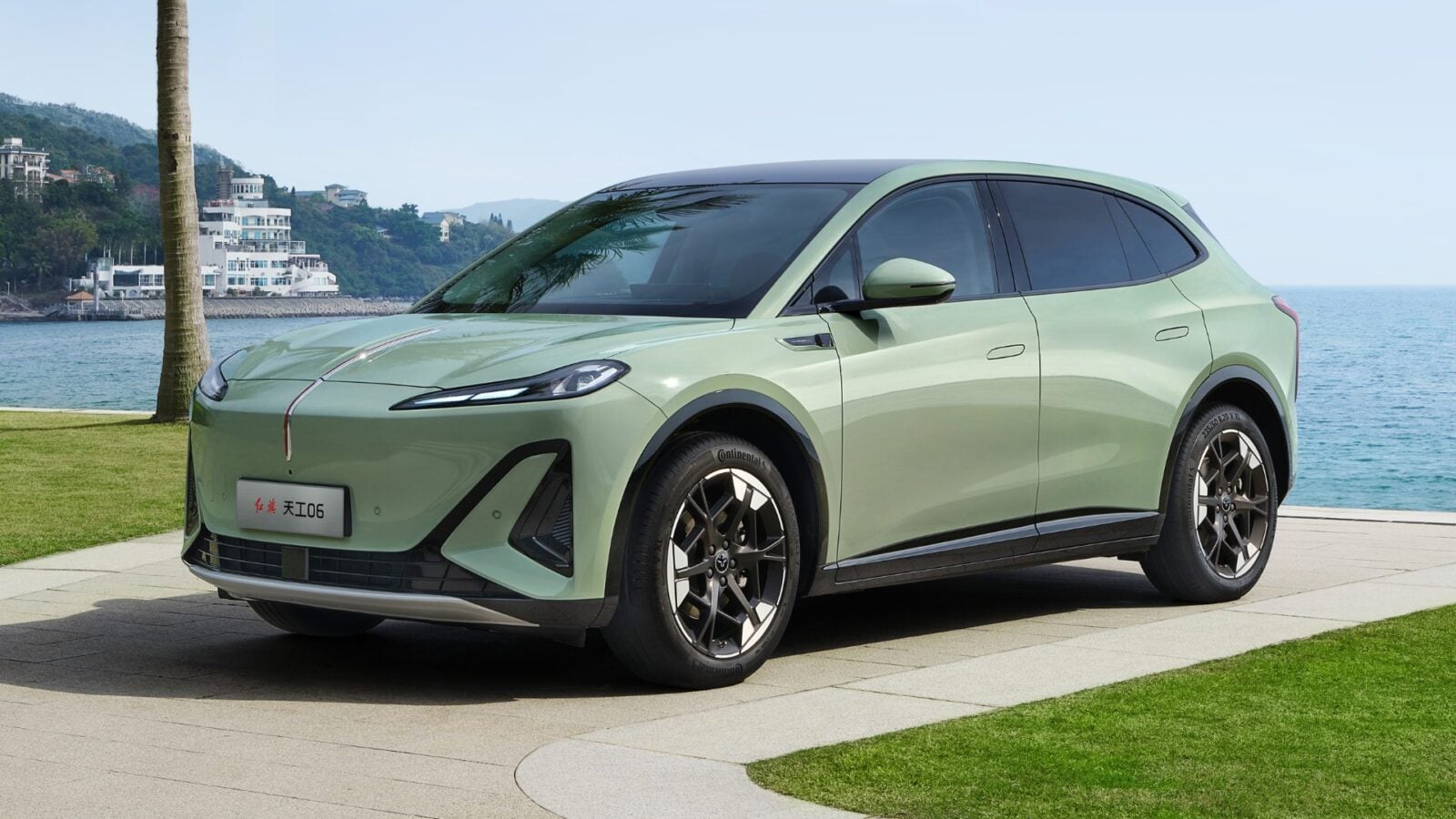
After Leapmotor and Dongfeng, another Chinese brand could take advantage of European factories to produce its electric cars. Hongqi would notably study avenues with Stellantis and Volkswagen. A win-win strategy, but which also involves risks for historic manufacturers.
After increasing the number of brand launches in Europe, Chinese manufacturers are gradually moving to a new stage of their development: producing directly on the Old Continent. A strategy which makes it possible in particular to avoid import surcharges for electric cars manufactured in China and to get closer to European markets. BYD and MG are preparing their own industrial facilities, while Dongfeng and Leapmotor can count on partnerships with Stellantis. Another brand could soon join this list: Hongqi, which would seek to rely on the infrastructures of Stellantis or Volkswagen.
The hypothesis of production of Hongqi electric cars in a European Stellantis factory has been circulating for several months. The Franco-Italian group has several industrial sites capable of hosting new models, particularly in Spain.
This path is not surprising when we know the industrial strategy currently pursued by Stellantis. The group has already started assembling Leapmotor vehicles in Europe in Poland at its Tychy factory with the small T03. The B10 and B05 SUVs must also benefit from Spanish production capacities at the Stellantis factory in Zaragoza. Another project concerns Dongfeng, with possible manufacturing of its vehicles in the Rennes factory which currently produces the Citroën C5 Aicross.
For Hongqi, this solution would make it possible to market its electric models more quickly in Europe without having to immediately invest in its own infrastructure. The brand could notably produce its EHS4 there, an electric SUV announced with up to 470 km of autonomy.
But Stellantis would not be the only European manufacturer to have been approached. Discussions with Volkswagen would also have been considered. The German group already maintains industrial relations with FAW in China, in particular for the development and production of certain electric vehicles. However, FAW is also the parent company of Hongqi.
An industrial merger could therefore seem logical on paper. Especially as Volkswagen seeks to improve the profitability of its activities and better exploit its production capacities. But the German manufacturer wanted to clarify that no official discussions had been initiated with FAW concerning the possible manufacture of Hongqi models in its European factories.
For Chinese brands, producing in Europe has several advantages. By using the factories of already established manufacturers, they can avoid financing the construction of new infrastructure, while reducing the constraints linked to the importation of vehicles manufactured in China. The models concerned can thus escape the additional customs duties applied to Chinese electric cars. This import tax has a strong impact on the selling price of Chinese electric cars in Europe.
European production can also facilitate access to certain purchasing assistance schemes. In France, vehicles assembled in Europe can claim the ecological bonus, provided they respect the eco-score criteria. A far from negligible element for manufacturers who rely heavily on aggressive prices to attract European motorists.
For their part, European groups also have reasons to welcome these new partners. Since 2019, the European automobile market has struggled to regain its pre-crisis volumes. However, the factories have been sized to produce many more vehicles than they currently assemble. Some therefore operate at a reduced rate, which weighs on their profitability and on the fixed costs of manufacturers.
Welcoming the production of Chinese models would then make it possible to better use existing facilities, but also to maintain employee activity. A way to make profitable industrial capacities which would otherwise remain under-exploited.
This strategy nevertheless carries a risk for European manufacturers. By helping their Chinese competitors to produce locally, they give them the means to circumvent some of the trade barriers put in place by the EU to slow down their development. The latter can thus strengthen their presence on the European market with potentially more aggressive prices.
Mazda finally corrects the big flaw of its electric sedan
Lucid Cosmos: this new affordable electric SUV wants to shake up the Tesla Model Y in Europe
No, it's not acceleration that most destroys electric car tires
BMW is preparing an electric monster for the start of 2027
Best electric charging card (2026): which one to choose?
Machine-translated from French
Not cross-checked yet
Only 01net reports this story so far. We show it as a single source until another newsroom confirms it.
- 01net22 Nov, 10:32
| Publisher 01net (general tier) | +72 |
| Detailed summary | +2 |
| Total | 74 |
Method: reports are grouped by the words of their headline and summary; each newsroom counts once; figures are read from the reports as published. Nothing here is written by an AI.