54 billion to transform the French economy: five years after its launch, has the “France 2030” investment plan kept all its promises?
If the Economic Analysis Council has judged favorably the effects of “France 2030” investments on the French economy, a report from the Court of Auditors is more cautious and highlights several weaknesses in the…
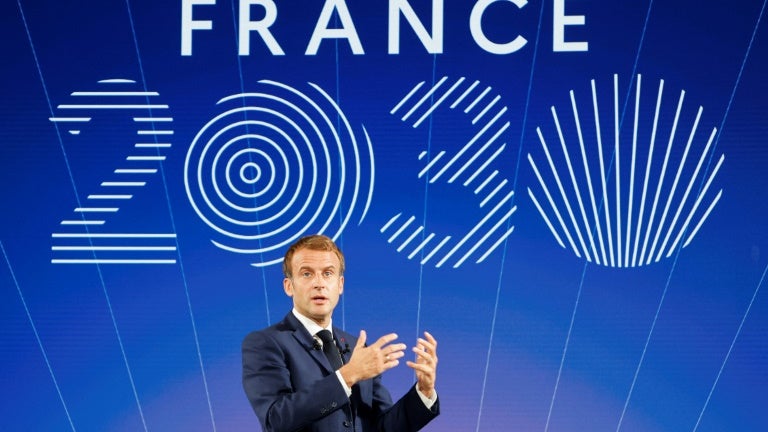
Will the French economy be ready to face the challenges of the 2030 decade? Launched in October 2021 by Emmanuel Macron, the “France 2030” plan of 54 billion euros was in any case aimed at preparing for it via massive investments in key sectors in order to “catch up with French industrial delay”, to help “innovative technologies” and to “support the ecological transition”. For what results?
Mid-term, “France 2030”, which is a continuation of the future investment programs (PIA) launched since 2010 and an extension of the post-Covid recovery plan, has recently been the subject of initial evaluations. In July, the General Secretariat for Investment welcomed an initial "promising" assessment, before mentioning "scientific, technological and industrial transformations underway", "innovative governance", and "confirmed macroeconomic profitability of investments" (5.4 euros of additional long-term wealth for one euro invested). Despite its cost, this plan "works very very well", Xavier Jaravel, president of the Economic Analysis Council (CAE), confirmed on BFM Business, because it "allows innovative companies to find credit that they would not have found in the private sector, to increase their sales, to increase their payroll and therefore the State's tax revenue".
“A plan like that pays for itself in 5 years, it allows productivity to be increased to such an extent that the State covers its costs,” continued the economist who also recommends a new “France 2040” plan, in particular to adapt to the AI revolution. An undeniable success then? The Court of Auditors is more cautious.
In a report published this Tuesday, the financial jurisdiction notes that "it is still difficult to measure the effects of the 'France 2030' plan, due to lack of sufficient perspective on the implementation of the projects" financed. In fact, only 642 of them out of around 7,300 - or less than 10% - were completed at the end of 2025.
However, “in the absence of a solid assessment of the effects of the plan on innovation and support for industries, it is premature to decide on the advisability of extending France 2030 or launching a new plan,” she judges. A "real absence of prioritization at the risk of dispersing the State's resources" Beyond the economic benefits of the plan, the Wise Men mainly focused on its implementation and deployment. And on this point, the results are rather mixed.
Certainly, the Court firstly welcomes "the speed of the deployment of 'France 2030'". Deployment facilitated by the use of four operators (Ademe, National Research Agency, Bpifrance and Caisse des Dépôts et Consignations) "already having recognized experience in their respective fields of expertise", which "made it possible to massively commit the open credits". However, this governance is considered "complex and not very open to stakeholders, in particular economic circles and local actors".
Machine-translated from French
Not cross-checked yet
Only BFM Business reports this story so far. We show it as a single source until another newsroom confirms it.
- BFM Business27 Oct, 20:00
| Publisher BFM Business (established tier) | +76 |
| Detailed summary | +2 |
| Total | 78 |
Method: reports are grouped by the words of their headline and summary; each newsroom counts once; figures are read from the reports as published. Nothing here is written by an AI.