9 years ago, Airbus buried their project: today the revolutionary hybrid plane of these 4 engineers which “takes off like a helicopter” is ready to take off
The Ascendance company, which unveiled this fully assembled aircraft on Thursday, November 19, claims to have already received more than 630 letters of intent to purchase for this hybrid vertical takeoff and landing…
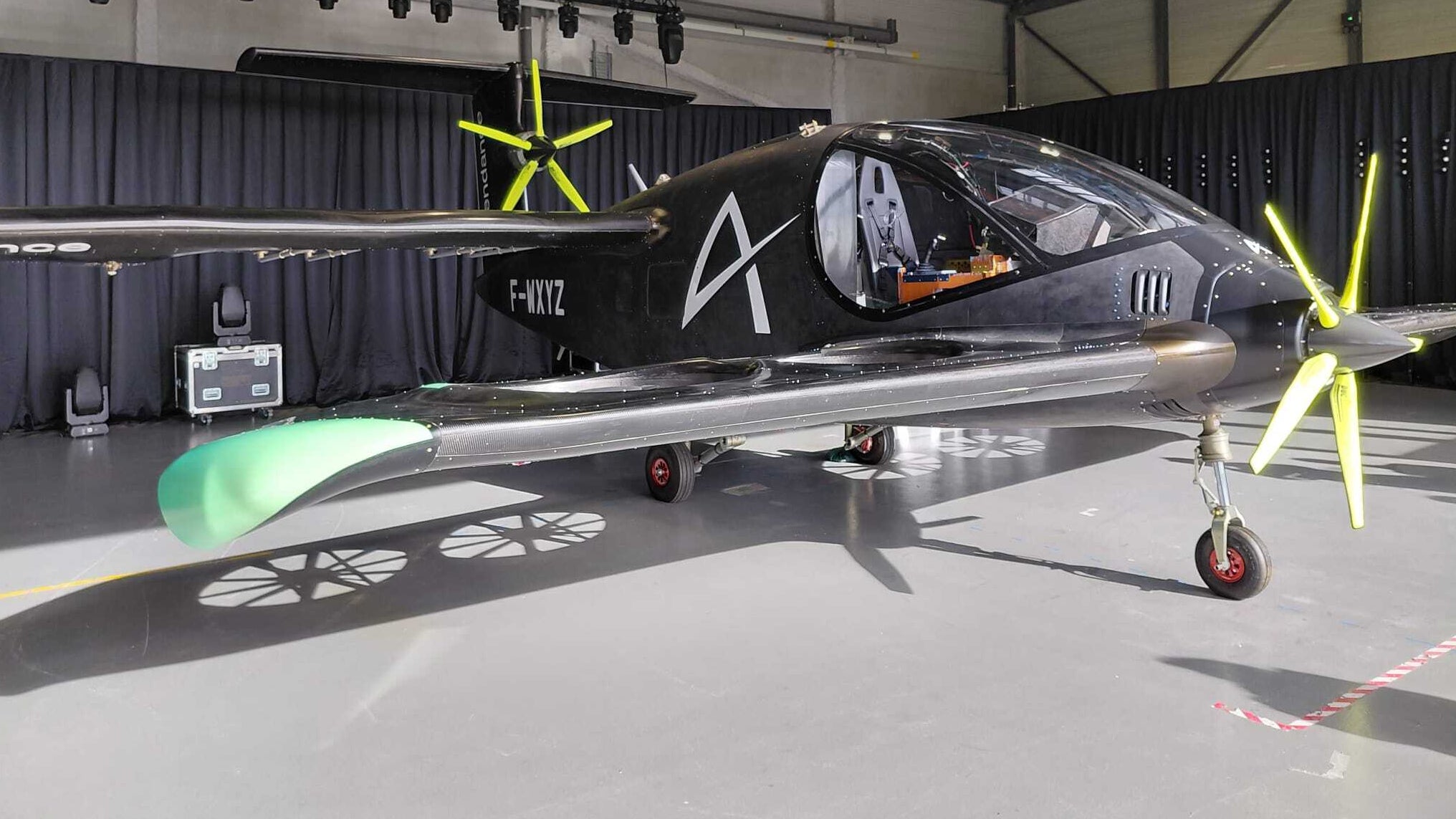
At Le Muret aerodrome, in Haute-Garonne, it’s time for pride this Thursday, November 19. Ascendance Flight Technologies unveils Atea, an aircraft presented as “double hybrid” and as the first European native hybrid aircraft by the company’s CEO and co-founder, Jean-Christophe Lambert. “It takes off like a helicopter and it flies like an airplane, so it has this hybridization between the helicopter and the conventional airplane.
And then it has this hybridization of engine, because it combines two sources of energy, so there are two revolutions, that's why this plane is unique," he explains to BFM Business. In this hangar, the carbon structure of the aircraft is astonishing with its eight rotors, integrated into its two wings. In front of this revolutionary plane, 14 meters wide by 9 meters long and which can accommodate up to 6 people, Jean-Christophe Lambert says “the moment of emotion” that this presentation constitutes for him and his team of around a hundred employees, eight years after creating his company.
Hybridization "will have a lasting impact on aviation" Let's go back in time: around 10 years ago, Jean-Christophe Lambert and the three co-founders of Ascendance were still working at Airbus. Within the European aviation juggernaut, they worked on the E-Fan project which aimed to create an electric-powered aircraft. In 2017, the program was abandoned, but nothing to discourage these four Airbus employees.
They then understand that the electric hybrid “will have a lasting impact on aviation”, unlike “all-electric which is too limited”. Cheaper, less energy-consuming and less noisy: at Ascendance, we have no doubt that the aviation of the future will be hybrid. Driven by this conviction, they left Airbus and started their company Ascendance.
The company has expanded since the first drawings in 2018 a few kilometers southwest of Toulouse. Already in size, with the recruitment of 100 engineers who work on a 1,200 m² site.
But also by the experience gained on the test bench installed on their site at the Muret aerodrome. Ascendance has completed 1,000 hours of testing on what looks like an airplane skeleton where cables and batteries are installed.
This is a real innovation laboratory to “compose as many configurations as possible”, explains Clément Dinel, director of hybridization, in the middle of the test bench. “We are going to base our concepts on it, we have filed 140 patents on hybridization,” he says with satisfaction. Atea is full of innovation, assures Ascendance.
“It is the catalyst for tomorrow’s aviation,” summarizes Jean-Christophe Lambert. “It has a new architecture, it has new aerodynamics, it has distributed propulsion, it has hybrid propulsion, it has electric flight controls. So it integrates all the technologies that will go on the planes of tomorrow,” he predicts.
Among these innovations, Sterna, the modular propulsion platform which makes it possible to hybridize the aircraft, is in a very good position. Chinese competition But there is still a long way to go before the French can see this revolutionary plane and its 400 kilos of electric batteries in the sky. First of all, you must obtain authorizations from EASA (European Union Aviation Safety Agency).
The tests will begin, first on the ground then at higher speed while taxiing. Then there are between a year and a half and two years of flight testing. The aircraft will first take off and land conventionally before converting to VTOL (Vertical Take-off and Landing).
“In aviation we like to discover the flight domain, so test little by little, and we made this choice to go there incrementally,” explains Jean-Christophe Lambert. So, what can this new type of aircraft be used for? With a claimed range of 900 kilometers at a target cruising speed of 250km/h, the range of possibilities is vast: organ transport, medical service, border surveillance or even going where nature makes journeys complex.
“The vertical takeoff and landing still allows agility which is very appreciable,” underlines Jean-Christophe Lambert. Another application imagined by Ascendance, the world of defense. Ascendance claims that its hybridization technology can increase the autonomy and stealth of a drone.
The company collaborates with the region's popular drone manufacturer Delair and its DT46 which equips the French army. Last month, it was with Naval Group that a memorandum of understanding was established to “develop new applications” for Ascendance’s hybrid solutions. But around the world, competition on the decarbonization of aviation is fierce, especially in the United States and China.
Compared to these two countries, the 60 million euros raised by Ascendance seem very paltry, according to the company's CEO. “It is clear that, on financing, we are talking about a ratio of 10 to 100, and we are closer to 100 than to 10. It is clear that we cannot have the same ambitions, it is not possible,” he clarifies.
“China has put hybridization technologies, these more electric technologies, these new aircraft, at the heart of their five-year plan,” explains Jean-Christophe Lambert. On November 14, the CE-25A, an electric regional aircraft from the Chinese public group Comac, made its first manned flight. So, at Ascendance, “we are waiting for a signal from France and Europe to be able to have the means to achieve our ambitions and to be in the race with China and the United States”.
With a weighty argument: before even having flown, the Atea has already been the subject of more than 630 letters of intent to purchase.
Machine-translated from French
Not cross-checked yet
Only BFM Business reports this story so far. We show it as a single source until another newsroom confirms it.
- BFM Business21 Nov, 10:18
| Publisher BFM Business (established tier) | +76 |
| Detailed summary | +2 |
| Total | 78 |
Method: reports are grouped by the words of their headline and summary; each newsroom counts once; figures are read from the reports as published. Nothing here is written by an AI.