“The VCs only think about that!” : start-up founders forced to prove that AI will not replace them to raise funds
Certain economic models worry investors, who question their sustainability in the face of progress in artificial intelligence.
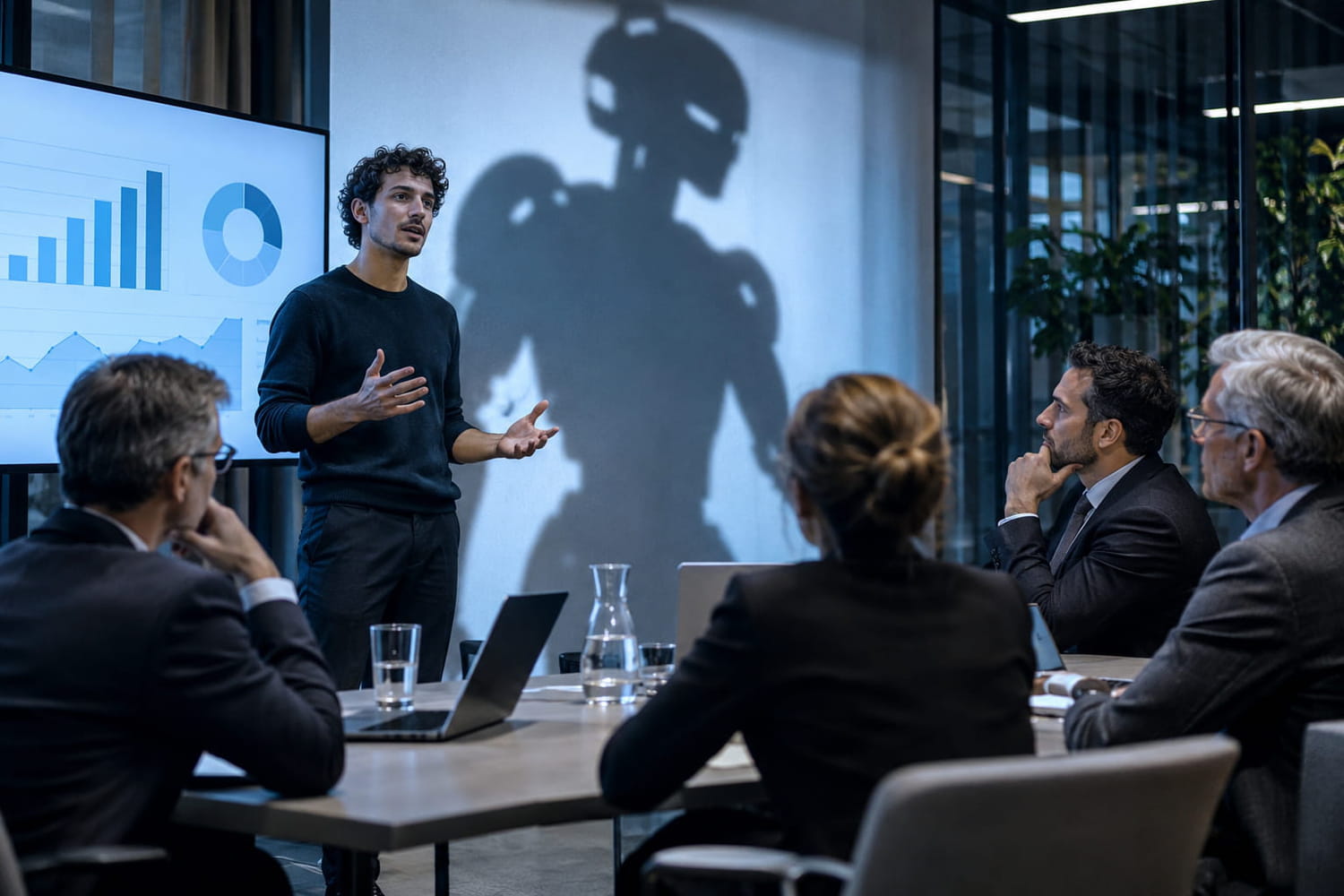
As 2027 approaches and the debates that lie ahead, the specter of the “great replacement” resurfaces. But not the one you're thinking of. In French tech, the fear is elsewhere: seeing artificial intelligence make entire economic models obsolete. To raise funds, start-up founders are now required to convince investors that their business will withstand the rapid progress of AI.
Alexandre Fitussi, founder of Beanstock, a platform that facilitates real estate investment, had to comply with this persuasion exercise. “It’s impossible to escape questions about artificial intelligence,” he says. “Investors are almost obsessed with it. They only think about it, to the point that the business plan has become secondary to the uncertainties linked to artificial intelligence. We have to show that we are capable of resisting it and that our business is not going to be replaced.”
On the other side of the table, do investors share this observation? Has the business plan really become “ancillary” to the threat of AI? “Go-to-market and customer relations remain essential,” explains Corentin Orsini, founder of Super Capital and Cercle Privé. “Yes, the barriers to entry have been lowered: what previously required a week of development can now be done in an hour. But you still have to know how to win over customers.”
Our expert, however, admits to having already “refused to invest in companies” for fear of seeing their activity one day replaced by AI. But how can founders reassure investors about their start-up’s ability to resist this threat? "Honestly, no one is safe. All companies can see their model called into question. But those which only offer a single functionality are the least attractive in our eyes. Overnight, this can be replaced by a simple line of code", warns Corentin Orsini.
Another warning sign: too much payroll devoted to administrative and management tasks. “We say that a new entrant into the same market could do without a large part of this workforce and thus gain competitiveness.” Finally, the investor warns companies reluctant to adopt AI: “Refusing to integrate it sends a very bad signal. Using AI to develop your product is the bare minimum.”
Conversely, certain start-ups seem to remain favored by investors, however spectacular the progress in AI may be. “Very specialized BtoB SaaS, positioned in niche markets still little penetrated by artificial intelligence, remain interesting investments,” underlines Corentin Orsini.
Companies with more concrete activities, anchored in the field, are also doing well. “Today, there are investors who are betting everything on AI and those who prefer to finance more traditional activities, less exposed to its upheavals. Start-ups positioned in these sectors therefore continue to attract capital.” Conversely, it is mainly general software that suffers from this polarization. “These companies constitute a sort of soft underbelly, increasingly threatened by AI. Many of them now have little reason to exist,” concludes Corentin Orsini.
Machine-translated from French
Not cross-checked yet
Only Journal du Net reports this story so far. We show it as a single source until another newsroom confirms it.
- Journal du Net9 Nov, 16:19
| Publisher Journal du Net (general tier) | +72 |
| Total | 72 |
Method: reports are grouped by the words of their headline and summary; each newsroom counts once; figures are read from the reports as published. Nothing here is written by an AI.