90% of Indonesian exports to the EU will be exempt from customs duties: Brussels formalizes a vast trade agreement with Jakarta (notably for textiles and palm oil)
According to the EU, this pact also removes customs duties on more than 98% of European exports to Indonesia, particularly for food, agricultural and industrial products. In return, Indonesia wants to strengthen its…
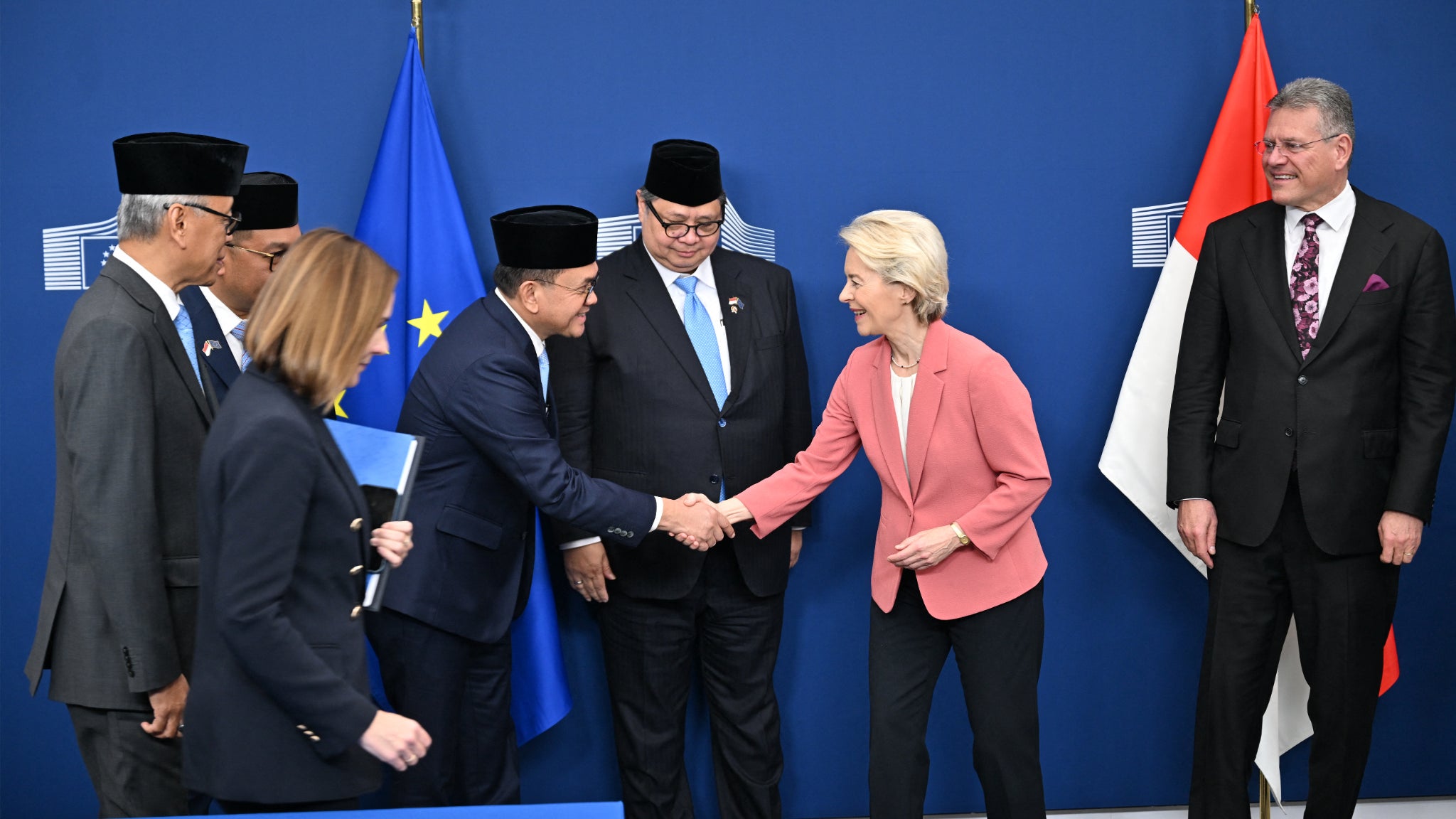
This is the culmination of 10 years of negotiations: the European Union (EU) and Indonesia officially signed, on Saturday November 21 in Brussels, a trade agreement aimed at opening their respective markets, which could come into force at the beginning of 2027. The President of the European Commission, Ursula von der Leyen, and the Indonesian Minister of Economic Affairs, Airlangga Hartarto, attended the signing ceremony of this agreement. “This is one of the most ambitious agreements that the European Union has concluded in Asia,” said Ursula von der Leyen.
According to Brussels, it should help increase EU exports to Southeast Asia's largest economy by almost 40% within 15 years. Negative trade balance for Brussels The European Commissioner for Trade, Maros Sefcovic, and the Indonesian Minister of Trade, Budi Santoso, were also present. “Together we represent a market of 730 million people,” added Ursula von der Leyen, thanking Indonesian President Prabowo Subianto who, she said, will visit Brussels on December 11.
Last year, trade between the EU and Indonesia reached 28.9 billion euros. The European Union imports more than it exports in value: it imported 18.7 billion euros of Indonesian products in 2025, compared to 10.2 billion euros of European exports to Jakarta. Negotiations on this agreement were concluded last year, almost a decade after their launch.
They intervene within the framework of a policy of diversification of the EU in its trade, while it faces challenges posed by the United States and China. These are, precisely, a Comprehensive Economic Partnership Agreement (CEPA) between Indonesia and the EU, as well as an Investment Protection Agreement (IPA). They will pave the way for investments in sectors such as electric vehicles, electronics and the pharmaceutical industry, Brussels said.
European food and industrial products, against textiles and palm oil According to the EU, this pact removes customs duties on more than 98% of European exports to this country, the fourth most populous in the world, notably on food, agricultural and industrial products. It will thus save more than 600 million euros in customs duties per year. Around 90% of Indonesian exports to the EU will be exempt from customs duties, the Indonesian Minister of Economic Affairs also said.
Stressing that this is expected to benefit Indonesia's main exports to the Union, including palm oil, footwear, textile products and fishery products. “The benefits for our exporters are concrete and measurable,” he said, welcoming a “new chapter” in economic relations with the EU. Ecological issues linked to deforestation and transport Palm oil and deforestation were blocking points during the negotiations.
However, the agreement provides for cooperation mechanisms on regulatory and sustainability issues, as well as a specific protocol devoted to palm oil. Many European and Indonesian civil society organizations oppose this free trade agreement. According to Brussels, this agreement will boost economic growth: by 2042, the EU's GDP is expected to be 16 billion euros higher, and that of Indonesia 27 billion euros, compared to what they would be without the agreement.
The European Parliament must still give the green light, and Indonesian authorities must complete the ratification process, before the agreement can provisionally enter into force.
Machine-translated from French
Not cross-checked yet
Only BFM Business reports this story so far. We show it as a single source until another newsroom confirms it.
- BFM Business21 Nov, 15:30
| Publisher BFM Business (established tier) | +76 |
| Checkable figures cited | +3 |
| Detailed summary | +2 |
| Total | 81 |
Method: reports are grouped by the words of their headline and summary; each newsroom counts once; figures are read from the reports as published. Nothing here is written by an AI.