+330% on the stock market in six months: after having made billions thanks to Covid then seeing its sales collapse by 90%, how the champion of the Moderna vaccine achieved its spectacular comeback
After building its success on its Covid-19 vaccine, Moderna is looking for a new growth engine. The American biotech is now banking on autogenous intismeran, a personalized therapeutic vaccine against cancer, developed…
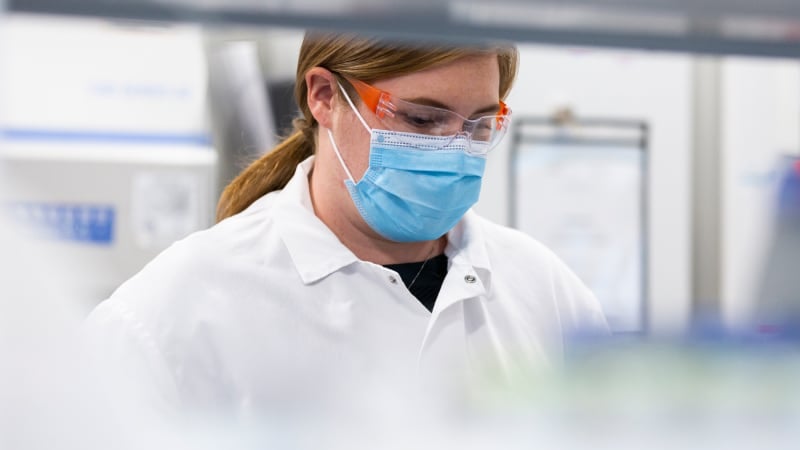
Six years after being propelled to the rank of pharmaceutical giant by the Covid-19 pandemic, Moderna is making a spectacular comeback. In six months, the American laboratory's shares have soared by some 330% on the stock market, one of the strongest gains of the year. An unexpected renaissance for a company whose sales had collapsed with the end of the health crisis.
Because Moderna has experienced an extraordinary trajectory in just a few years. Its turnover, which barely reached 800 million dollars in 2020, had exploded to 19.3 billion in 2022 thanks to the success of its vaccine against Covid. But the fall was almost as dizzying: in 2025, its revenues had fallen to around $1.9 billion, "We went from zero sales to $18 billion in one year [...]
] Then we went from 18 to 2 billion dollars", summed up Stéphane Bancel, the French boss of Moderna, on BFM Business last June. So how did the laboratory manage to win back investors? The answer lies largely in a new bet: using messenger RNA technology, which made its fortune during Covid, to attack cancer this time.
With its partner Merck, Moderna is developing a personalized vaccine against certain forms of cancer. Unlike traditional vaccines, this one does not prevent the disease from appearing: it is tailor-made from the patient's tumor to help their immune system fight cancer cells. Results from an advanced melanoma trial showed a 42% reduction in the risk of recurrence or death compared to standard-of-care treatment alone.
Results which have revived the hopes of investors, even if the path towards large-scale commercialization remains strewn with obstacles. A return to Moderna’s initial ambitions The stakes go far beyond just the anti-cancer program. Created in 2010 in Cambridge, Massachusetts, Moderna built its model on one idea: using messenger RNA to develop new drugs against many diseases.
“We launched Moderna 15 years ago with this vision that messenger RNA would make it possible to manufacture drugs in many categories, including treatments that were impossible to design with existing technologies,” recalled Stéphane Bancel, on the show Good Morning Business last June. The Covid-19 pandemic has brought dramatic validation to this technology. Thanks to its vaccine against SARS-CoV-2, Moderna has gone from the status of a promising biotech to that of a giant in respiratory vaccines.
Its turnover jumped from around 800 million dollars in 2020 to 19.3 billion in 2022. The fall was then just as brutal with the decline in global demand for vaccines against Covid. Moderna's turnover has plummeted.
The health crisis has also changed the company's priorities. “We bet on Covid because it was the right thing to do. Our clinical studies on cancer were therefore significantly delayed at that time,” explained the manager.
“Now we are returning to our core business, being the most important company in messenger RNA and developing drugs in all these areas. It is not a company that has one product to prove, but four,” he added. Like Pfizer and BioNTech, the company must now demonstrate that it can sustainably revive its growth and shed its image of success exclusively linked to the pandemic.
Despite the development of new versions of its vaccines against Covid and products combining Covid and flu in particular, investors were expecting a major growth driver. Oncology could therefore fulfill this role. And melanoma could be just the first step.
Moderna and Merck are also evaluating their personalized vaccine against several other cancers, including lung, kidney and bladder. The aim is to demonstrate that this technology can be used against different forms of tumors, and not just skin cancer. However, investor enthusiasm is not without limits.
After jumping nearly 180% in a single session in August, Moderna shares suddenly fell by more than 25% on October 22. At issue: detailed results on its cancer vaccine considered less spectacular than hoped for by certain analysts. Moderna is already preparing for possible commercialization. The biotech now hopes to transform this clinical success into a commercial product.
During its investor day on November 12, 2026, Moderna indicated that it was aiming to submit an authorization request to the Food and Drug Administration, the FDA, before the end of the year. Subject to the green light from the American regulator, intismeran could thus be launched in the United States as early as 2027, according to the transcript of this presentation. The company is already preparing for the industrial stage.
Its specialized facility in Massachusetts is expected to support commercial production of the treatment if approved. The challenge is considerable: unlike a mass-produced drug, each dose of intismeran must be designed based on the characteristics specific to the patient's tumor. This infrastructure must make it possible to manage the entire process, from the analysis of the tumor and the selection of neoantigens to the manufacturing and delivery of the individualized vaccine.
Moderna has announced that it will submit an application for authorization of this vaccine in early 2027. However, marketing remains planned. It will depend on the examination of the file by the FDA, the possible authorization of the treatment and the capacity of the two partners to implement large-scale personalized production.
This strategy nevertheless remains expensive. According to Barron's, Moderna anticipates around $4 billion in cash outlays in 2027, then between $4 and $4.5 billion per year until 2030. The company will therefore need to increase its revenues to return to sustainable profitability.
Since the end of the pandemic, it has not managed to generate an annual profit. For now, its Covid products remain essential to its turnover. International vaccine sales recently contributed to a 29% quarterly increase in revenues, according to the American media.
During its investor day, Moderna presented intismeran as one of the pillars of its next phase of growth. Management intends to reinvest part of the savings made in advanced clinical trials, production capacities and the preparation of future launches, particularly in oncology. The launch of intismeran and other drugs in development will therefore be decisive.
Any clinical, regulatory, industrial or commercial disappointment could weigh on the accounts and the stock price. A market still limited, but expected to boom According to Grand View Research, the global market for personalized cancer vaccines, still embryonic, was valued at around $208 million in 2024. It could reach $1.45 billion in 2030, a seven-fold increase in six years and average annual growth close to 45%.
In France, Grand View Research estimates that this market could increase from 7 million dollars in 2024 to 52 million in 2030. Moderna has therefore succeeded in convincing Wall Street that it could have a second life after Covid. It now remains to transform this promise into commercial success.
Because although the laboratory has regained favor with investors, it has not yet returned to profit. And its future still largely depends on its ability to make messenger RNA something other than a technology that triumphed during a pandemic.
Machine-translated from French
Not cross-checked yet
Only BFM Business reports this story so far. We show it as a single source until another newsroom confirms it.
- BFM Business21 Nov, 12:46
| Publisher BFM Business (established tier) | +76 |
| Detailed summary | +2 |
| Total | 78 |
Method: reports are grouped by the words of their headline and summary; each newsroom counts once; figures are read from the reports as published. Nothing here is written by an AI.